James the brother of Jesus is usually known as ‘James the Just’. He was the first leader of the Jerusalem Church following the death of Jesus. He believed in doing ‘good works’, which is closer to our concept of ‘Common Decency’ or ‘be good to others’. This is different to the Pauline claim that ‘faith’ in God and Jesus is the prime requirement in ‘Church’ version of Christianity.
“… faith, if it has no works, is dead ….” — James 2:17
The Jamesian prescription for salvation by ‘works’. Effectively, believing in God, the holy Trinity, and so forth is secondary.
I am always careful to separate Church from Christianity. I define Christianity as following the ‘Philosophy of Jesus’. Thus, you do not need to go to church to be a Christian. I say that the ‘Real Christianity’ is the Christianity taught to us by our mothers. Even if mother never mentions the word ‘Jesus’, she teaches us to respect others and be good to others. Non-Church goers will often state to me words similar to: “Treat others as you wish to be treated yourself.” This is the core of Christianity. Mothers manage to teach us how to recognize ‘right’ from ‘wrong’ with out using a rule-book. I might sit at a table with a group of young people and one will say: “That is wrong.” Yet, there is no rule outlawing the action. If somebody jumps into a queue to the detriment of others, people will be annoyed, yet there is no rule on queuing. Our Christian upbringing teaches us to distinguish right from wrong without using a rulebook. Jesus is arguably the greatest moral crusader in history, even if many of his ideas come from other places. The good parts of previous religions certainly influenced his teachings.
If the ‘organized’ Church had followed ‘James the Just’ rather than Paul, our Church of today would likely be a far better Church.
James the Just is listed as the leader of the ‘Jerusalem Church’ or ‘Assembly’ in Acts 12:17. In the Jerusalem of his time, which was about 40AD to 60AD, he was the most important figure in Christianity. He was ‘the Bishop’ or ‘Overseer’ of the Jerusalem Church. James is the person referred to in the ‘Dead Sea Scrolls’ as ‘the Teacher of Righteousness’ or ‘Righteous Teacher’. He was called: ‘James the Just’ because of his ‘Righteousness’ and ‘Piety’. James the Just, also known as ‘Old Camel Knees’, led the church at Jerusalem until his violent death in 62AD.
As ‘Bishop’ of the Jerusalem Ecclesia, he was effectively seen as head of world Christianity. This created a problem for those taking Christianity to far-away places and to those wishing to modify it into a religion to suit the Roman Empire.
Muslims claim that the Bible has been corrupted. This is a significant point of contention between Christians and Muslims. “Allah has told you that the people of the Scriptures have changed some of Allah’s Books and distorted it…” [Hadith. Abdullah bin `Abbas.] Read ‘Allah’ as ‘God’. They claim that the wrong person was nailed to the scaffold.
Jesus came from a large family. Matthew 13:55-56 names the brothers of Jesus as: James, Joseph, Simon, and Judas. Matthew 13:55-56 also mentions his sisters. Thus, Jesus had at least six siblings.
James is always named first when his brothers are listed. This hints that James the Just was the eldest of the four brothers.
The Church set itself up to dictate and control society using its version of Christianity as its medium. The Church as we know it today was effectively created along the lines of the teachings of Paul as modified by the Council of Nicea in 325AD. This has differences to the teachings of James the Just, the brother of Jesus.
James the Just, the brother of Jesus is not well known to Christians because he has effectively been written out of the Church documentation.
We need to rescue the history of James, the brother of Jesus. He played a major role in the early years of Christianity before the ‘Church’ as we know it existed.
We have to be careful. Numerous artful explanations have been applied to the teachings of Jesus to make him appear as a ‘failed’ offshoot of Judaism.
The question is whether, to be a Christian, a Gentile believer had to first become a Jew and follow the Torah, including undergoing circumcision and maintaining kosher dietary practices. Paul maintained that Jesus’ death had done away with the old Covenant with the Jews and so made this unnecessary. Paul was preaching far away from Jerusalem to Goyim, the Jewish derogatory slang term for non-Jews.
Though initially skeptical, James, the brother of Jesus became a follower of Jesus after the resurrection of Jesus, advocating for a faith accompanied by actions. Please note ‘faith’ ‘accompanied by actions’. Most ordinary people who are nominally Christians accept that the core of their philosophy requires ‘being good’ to go to heaven. They lean towards ‘actions’ rather than faith. They are following the ‘philosophy of Jesus’ as taught by James rather than the Catholic Church with its ‘tithes’ or Martin Luther with his ‘faith alone’.
James taught that true faith must be accompanied by practical actions. This is a theme he reinforced in his letter in the New Testament, the Book of James.
James is called “the Just” because of his commitment to prayer, integrity, and zeal for justice. As a leader in Jerusalem, he guided the church through a period of great tension between Jewish Christians and foreign believers, promoting unity. James participated in the Council of Jerusalem. Here, it was decided that Christians from other cultures did not need to follow all Jewish custom, such as circumcision.
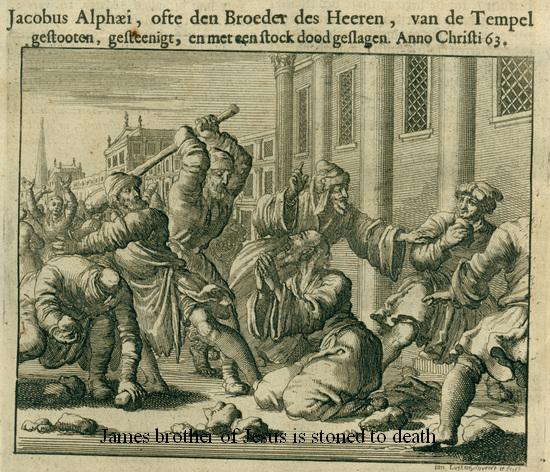
The historian, Josephus tell us that James died for his faith around 62 AD. Jewish religious leaders took him to the temple in an attempt to force him to renounce his faith in Jesus. When he refused, he was thrown from a height and, still alive, was stoned to death. From this statement, you can see that there is a big difference between the philosophy of Judaism and Christianity. As Christians, we do not accept throwing persons from rooftops for their beliefs. We consider that to be murder.
The aforementioned Scribes and Pharisees therefore placed James upon the pinnacle of the temple, and cried out to him and said: “You Just One, in whom we should all to have confidence, forasmuch as the people are led, astray after Yeshua, the crucified one, declare to us, what is the gate of Yeshua.” And he answered with a loud voice, “Why do you ask me concerning Yeshua, the Son of Man? He himself sits in heaven at the right hand of the great Power, and is about to come upon the clouds of heaven.” And when many were fully convinced and gloried in the testimony of James, and said, “Hosanna to the Son of David,” these same Scribes and Pharisees said again to one another, “We have done badly in supplying such testimony to Yeshua. But let us go up and throw him down, in order that they may be afraid to believe him.” And they cried out, saying, “Oh! Oh! The just man is also in error.” And they fulfilled the Scripture written in Isaiah, “Let us take away the just man, because he is troublesome to us: therefore they shall eat the fruit of their doings” [Isaiah 3:10 LXX].
So they went up and threw down the just man, and said to each other, “Let us stone James the Just.” And they began to stone him, for he was not killed by the fall; but he turned and knelt down and said, “I entreat you, Lord God our Father, forgive them, for they know not what they do” [Luke 23:34]. And while they were stoning him one of the priests of the sons of Rechab, the son of the Rechabites, who are mentioned by Jeremiah the prophet, cried out, saying, “Stop! What are you doing? The Just One prays for you.” And one of them, who was a fuller, took the club with which he beat out clothes and struck the just man on the head. And thus he suffered martyrdom. And they buried him on the spot, by the temple, and his monument still remains by the temple. (Eusebius, History of the Church 2.23.4, 10–18)
After the Crucifixion of Jesus, James became one of the improtant leaders of the church in Jerusalem. He became known as “James the Just” because of his upright life, his dedication to prayer, and his commitment to justice as conveyed in Acts 15:13-21. He helped decide that Gentiles (non-Jews) could be part of the church without needing to follow all the Jewish laws. He went from being someone who didn’t believe to becoming an important leader in the church.
Comments:
The gospel Jesus taught emphasized the usefulness of effort and that divinity is within the person. Friedlander correctly concludes: “Christianity is not of the world—Judaism is of the world” (180-81).