
How a 4th-century meeting of bishops turned Jesus into God and handed Christianity to the Roman Empire.
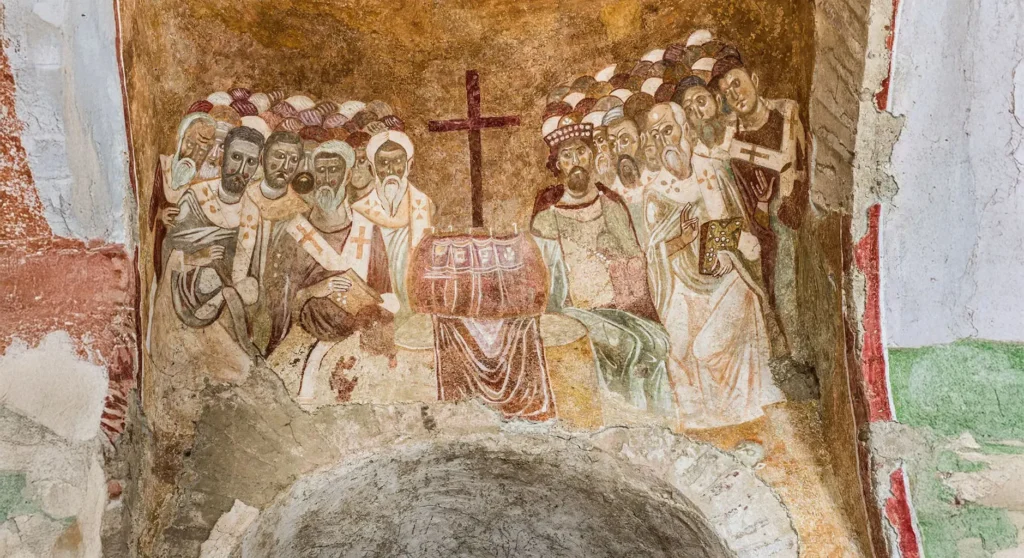
The year was 325 AD. Christianity was no longer a hunted underground faith — it was becoming the empire’s new favorite tool. Emperor Constantine, a shrewd politician first and a “Christian” second, saw religion as a way to glue his shaky empire back together. Pagan cults were splintered, Christians were fighting each other over doctrine, and unity was slipping. So, Constantine did what emperors do best: he called a meeting and told everyone to shut up and agree.
That meeting became known as the Council of Nicaea, and it changed Christianity forever. It didn’t just decide what people should believe about Jesus — it defined who Jesus was. It drew the line between “true believers” and “heretics,” and gave birth to the Church’s obsession with controlling belief.
If Christianity were a company, Nicaea was the board meeting where the CEO, namely Constantine, forced the managers, a.k.a. the bishops, to agree on the brand identity — no matter who got fired.
The Mess Before Nicaea
Before Nicaea, Christianity was in chaos. Different regions had different gospels, rituals, and theologies. Some Christians believed Jesus was divine from birth. Others thought he became divine after the resurrection. Some worshipped him, others saw him as a human prophet.
There were Gnostics who believed the physical world was evil, Ebionites who saw Jesus as a Jewish reformer, and Docetists who said he only appeared to have a body. In short, early Christianity looked more like a family argument than a religion.
The biggest fight, though, came from a man named Arius, a priest from Alexandria. Arius was logical to the core — too logical for the church’s liking. He taught that God the Father existed first and created Jesus later. So, Jesus couldn’t be equal to God. He was divine, yes, but not the God. Arius famously said, “There was a time when the Son was not.”
That one sentence nearly blew up Christianity.
His opponents, led by Bishop Alexander and his young protégé Athanasius, were furious. They insisted Jesus was eternal, “of the same substance” as the Father. Not similar — the same. If Jesus wasn’t fully divine, then the entire salvation story fell apart. Who wants to pray to a half-god?
By the time Constantine heard about this mess, churches were rioting, bishops were excommunicating each other, and the empire’s favorite new religion looked like it might tear itself apart. Constantine didn’t care who was right — he just wanted the fighting to stop.
In the early centuries, Christianity was not a single, unified movement, but a collection of diverse and often conflicting groups — Bart D. Ehrman, Lost Christianities: The Battles for Scripture and the Faiths We Never Knew (Oxford University Press, 2003)
Constantine Steps In
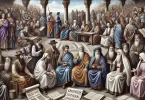
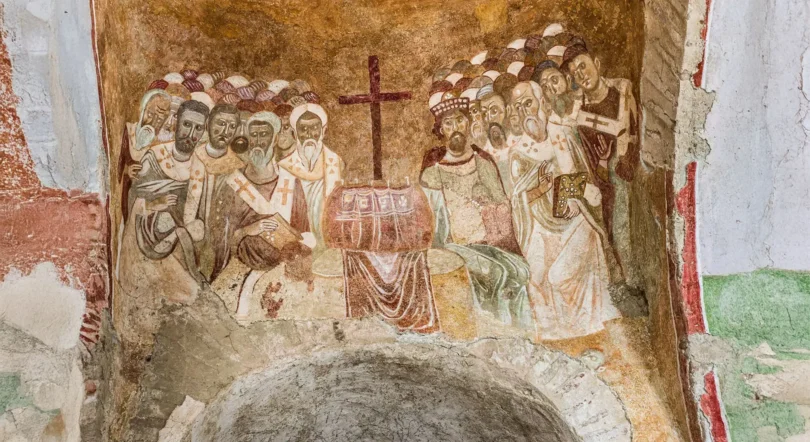
When Constantine called the Council of Nicaea, he had anything but faith in mind. He needed a united religion to stabilize his rule. A divided church meant a divided empire. So, he summoned bishops from all over the Roman world to the city of Nicaea (today’s İznik, Turkey). Around 300 bishops showed up — old, cranky, and ready to argue.
They came from everywhere: Egypt, Syria, Greece, North Africa, even Spain. Many had scars from earlier persecutions — missing eyes, broken bones, or burn marks. Now they were sitting in a palace, paid for by the same empire that once tried to kill them.
Constantine sat at the center of the room in imperial robes, a living reminder that the emperor — not the church — held the real power. He told them to settle the “Arian problem” once and for all. And when the most powerful man on Earth tells you to reach a decision, you reach one.
The Empire’s New Script
After weeks of shouting, arguing, and probably a few punches thrown, the bishops drafted a short but explosive statement: the Nicene Creed.
It declared that Jesus Christ was “begotten, not made, of one substance (homoousios) with the Father.” That single Greek word — homoousios — crushed Arianism. It meant Jesus wasn’t created, but eternal. Not just godlike, but God Himself.
In plain terms, Nicaea officially made Jesus equal to God the Father. Christianity now had its two-for-one deity.
Arius and his followers refused to sign, saying the Creed was unbiblical. Constantine exiled them and ordered their writings burned. Problem solved — at least for a while.
The Nicene Creed became the official definition of Christian belief. Anyone who disagreed was branded a heretic. It was the church’s first loyalty oath. From that day, Christianity stopped being about faith alone — it became about agreement.
You either said the magic words or risked banishment, torture, or death.
The Council of Nicaea was as much a political act as a theological one. Constantine wanted unity, not necessarily truth — Karen Armstrong, The Case for God (Knopf, 2009)
The Arian Comeback
Of course, ideas don’t die just because emperors say so. After Constantine’s death, his sons took over — and guess what? Some of them were Arian sympathizers. They reversed his decisions, brought Arian bishops back, and exiled Athanasius (more than once). For decades, the Roman Empire swung back and forth between Nicene and Arian Christianity like a seesaw.
At one point, even the emperor was Arian. Churches were seized, bishops were imprisoned, and mobs fought in the streets. If Christianity was supposed to bring peace, it sure had a funny way of showing it.
Athanasius, the stubborn defender of Nicaea, spent nearly twenty years in exile. But he never gave up. His writings became the rallying cry for pro-Nicene believers, and by the end of the 4th century, Arianism was crushed. The emperor Theodosius I declared Nicene Christianity the official religion of the empire in 380 AD. From that point on, Rome and the church were married — and divorce was not an option.
Arius sought to preserve the absolute uniqueness of God by arguing that the Son was a created being, subordinate to the Father. His opponents saw this as a denial of salvation itself — Rowan Williams, Arius: Heresy and Tradition (Eerdmans, 2001)
Politics as Theology
What most people forget is that Nicaea wasn’t a divine revelation — it was a political settlement. Constantine didn’t care whether Jesus was of the same substance or a similar one; he cared about unity. The bishops used imperial power to turn theological opinions into law.
That’s when Christianity stopped being a movement of spiritual rebels and became an institution of control.
Before Nicaea, people could interpret Jesus’ nature freely. After Nicaea, disagreement became a crime. Faith turned into dogma. Thought turned into obedience.
The Nicene Creed wasn’t the voice of God — it was the voice of empire.
The church used it to draw lines between “orthodox” and “heretic,” “faithful” and “blasphemer.” In the centuries that followed, thousands would die for being on the wrong side of those lines. Heresy hunts, inquisitions, and excommunications all grew from that seed planted in Nicaea.
The Emperor Becomes a Bishop
Nicaea also set a dangerous precedent: the emperor now had a seat at God’s table. Constantine saw himself as God’s chosen ruler, a sort of thirteenth apostle in purple robes. When later emperors wanted to push doctrine, they followed his lead.
This fusion of church and state would shape Europe for the next thousand years. Kings ruled “by the grace of God,” popes crowned emperors, and both sides used faith to justify wars, taxes, and executions.
The same pattern would repeat again and again: theology decided by power, not revelation.
What Christianity Lost
By defining Jesus as fully divine, Nicaea locked Christianity into a puzzle it could never fully solve. If Jesus is God, how can he pray to God? How can he die? How can he not know the day of judgment (as he admits in Mark 13:32)? The Trinity — the idea that God is one being in three persons — was invented later to patch up those contradictions, but it only made the logic worse.
Early Christian diversity — dozens of perspectives and debates — was buried under the weight of a single imperial truth. The council froze Christianity into a formula: Father, Son, Holy Spirit, same essence, no questions asked.
And yet, the Bible itself never uses the word Trinity. Jesus never claimed equality with God. The idea that a Jewish preacher from Galilee was the eternal Creator of the universe would’ve shocked the earliest followers.
But after Nicaea, that became official belief. Dissenters were silenced. Other gospels were banned. And Christianity, once a radical grassroots movement, became an imperial religion with a creed to memorize and enemies to destroy.
By turning theological debates into imperial decrees, the Church set a precedent that faith would henceforth be enforced by law rather than persuasion — Elaine Pagels, The Gnostic Gospels (Random House, 1979)
The Legacy That Still Rules
To this day, the Nicene Creed is recited in churches worldwide. Every Sunday, millions repeat lines crafted by bishops under imperial pressure 1,700 years ago.
People rarely realize that those words were written in Greek, argued in Latin, enforced by soldiers, and finalized under a pagan emperor who was baptized only on his deathbed — by an Arian bishop, no less. Yes, the man who called Nicaea was baptized into the very heresy it condemned.
If that doesn’t sum up the hypocrisy of early church politics, nothing does.
The Council of Nicaea wasn’t just about theology — it was about control. It turned a scattered faith into a single empire-approved religion. It gave birth to orthodoxy, dogma, and the idea that questioning authority is the same as questioning God.
In that sense, Nicaea didn’t just define Jesus — it defined the rules of Christian power.
Before You Go
The Council of Nicaea was supposed to end division, but what it really did was draw battle lines. It created a version of Christianity that could serve the empire, not necessarily the truth. Maybe that’s why so much of Christian history afterward is filled with councils, schisms, and reformations — because people kept realizing that what was “decided” in 325 didn’t always match what Jesus actually taught.
If the Nicene Creed represents unity, it’s the kind built by hammer and sword. It froze the wild, living arguments of early Christians into a corporate slogan that still echoes today: “We believe…”
But the real question is — who’s “we”? The faithful, or the ones who wrote the rules?