

This article is by Nicholas Lyssson.
One might think the worst holocaust deniers—at least the only ones who command serious attention—are those who insist the Nazi holocaust, as it involved the Jews only, was without parallel.
Guenter Lewy argues for example in The Nazi Persecution of the Gypsies (Oxford University Press, 2000) that while the Gypsies were gassed, shot and otherwise exter-minated in great numbers, right alongside the Jews, they were not true victims of “the” Holocaust (capital “H”) but only of something collateral. Lewy even suggests the Gypsies invited their own destruction with certain cultural traits—in particular, sharply divergent moral standards for dealing among their own and with outsiders.
But pre- or anti-Enlightenment Judaism is hardly a less ethnocentric or hostile moral system. As Edward Gibbon correctly notes in The Decline and Fall of the Roman Empire, vol. 1, ch. 15 (1776), “the wise, the humane Maimonides openly teaches [in The Book of Torts, 5:11] that, if an idolator fall into the water, a Jew ought not to save him from instant death.” See also Rabbi Simeon ben Yohai’s remarkable second-century exercise in ejusdem generis: “The best of the heathen merits death; the best of serpents should have its head crushed; and the most pious of women is prone to sorcery” (Yer. Kid. iv. 66c; Massek. Soferim xv. 10; comp. Mek., Beshallah, Wayehi, 1, and Tan., Wayera, 20, all as cited by JewishEncyclopedia. com). For “heathen” some translators simply write “goyim”; for “prone to sorcery” they write “a witch.” Rabbi Simeon is mentioned more than 700 times in the Talmud.
Israel Shahak and Norton Mezvinsky, in Jewish Fundamentalism in Israel (2d ed. 2004), say (p. 1) “that in the usual English translations of talmudic literature some of the most sensitive passages are usually toned down or falsified,” and indeed (pp. 150-51) that “the great majority of books on Judaism and Israel, published in English especially, falsify their subject matter,” in part by omitting or obscuring such teachings. For a fuller discussion of the point, see Shahak, Jewish History, Jewish Religion: The Weight of Three Thousand Years, esp. ch. 2 (1994), available online. As to Jews, Gypsies or anyone else, of course, ethnocentrism or even outright cultural hostility as a rationale for genocide is obscene.
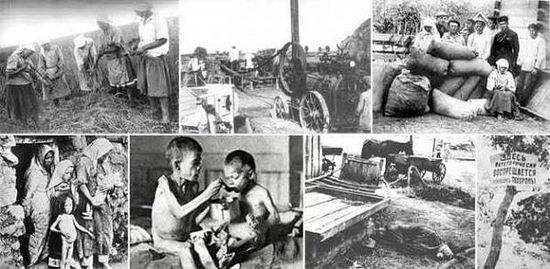
A particularly relevant parallel to the Nazi holocaust is the Ukrainian holodomor of 1932-33, a state-created famine — not a crop failure — that killed an estimated five million people in the Ukraine, one million in the Caucasus, and one million elsewhere after the Soviet state confiscated the harvest at gunpoint. Throughout the famine, the state continued to export grain to pay for industrialization. See Robert Conquest, The Harvest of Sorrow (Oxford University Press, 1987). Norman Davies gives the following description in Europe: A History, p. 965 (Oxford University Press, 1996). His first paragraph assembles quotations from Conquest; the bracketed phrase is his own:
“A quarter of the rural population, men, women and children, lay dead or dying” in “a great stretch of territory with some forty million inhabitants,” “like one vast Belsen.” “The rest, in various stages of debilitation,” “had no strength to bury their families or neighbours.” “[As at Belsen] well-fed squads of police or party officials supervised the victims.”
. . . All food stocks were forcibly requisitioned; a military cordon prevented all supplies from entering; and the people were left to die. The aim was to kill Ukrainian nationhood, and with it the “class enemy.” The death toll reached some 7 million. The world has seen many terrible famines. . . . But a famine organized as a genocidal act of state policy must be considered unique.
See also Oksana Procyk, Leonid Heretz and James E. Mace, Famine in the Soviet Ukraine, 1932-33 (Harvard University Press, 1986); Nicolas Werth, “The Great Famine,” in Stephane Courtois, et al., The Black Book of Communism, pp. 159-68 (Harvard University Press, 1999); Edvard Radzinsky, Stalin, pp. 257-59 (1996); Miron Dolot, Execution by Hunger (1985); Simon Sebag Montefiore, Stalin: The Court of the Red Tsar, pp. 84-85(2003); and the Commission on the Ukrainian Famine, Report to Congress (1988). That report, at pp. 6-7, cites estimates of the number killed that range as high as 8 million in the Ukraine and 9 million overall.
Piers Brendon, The Dark Valley, pp. 248-49 (2000) gives this description, drawn from still further sources, all cited in his notes:
A population of “walking corpses” . . . even ate horse-manure for the whole grains of seed it contained. . . . Cannibalism became so common-place that. . . local authorities issued hundreds of posters announcing that “EATING DEAD CHILDREN IS BARBARISM.”. . .
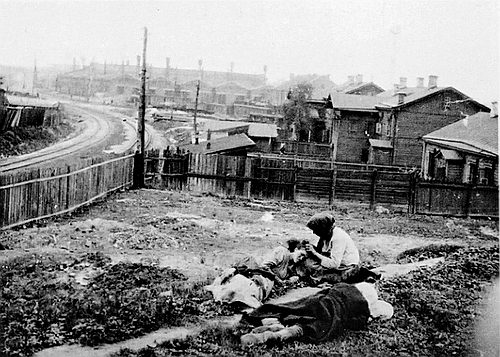
They staggered into towns and collapsed in the squares. . . . Haunting the railway stations these “swollen human shadows, full of rubbish, alive with lice,” followed passengers with mute appeals. . . . [They] “dragged themselves along, begging for bread or searching for scraps in garbage heaps, frozen and filthy. Each morning wagons rolled along the streets picking up the remains of the dead.” Some were picked up before they died and buried in pits so extensive that they resembled sand dunes and so shallow that bodies were dug up and devoured by wolves.
Boris Pasternak says “what I saw could not be expressed in words. . . . There was such inhuman, unimaginable misery, such a terrible disaster, that it began to seem almost abstract, it would not fit within the bounds of consciousness.” See Brian Moynahan, The Russian Century, p. 130 (1994). Nikita Khrushchev, in Khrushchev Remembers: The Final Testament, p. 120 (1976), says “I can’t give an exact figure because no one was keeping count. All we knew was that people were dying in enormous numbers.”
According to S. J. Taylor, Stalin’s Apologist: Walter Duranty, The New York Times’s Man in Moscow, p. 202 (Oxford University Press 1990), “. . .Soviet authorities . . . require[d] that the shades of all windows be pulled down on trains traveling through the North Caucasus, the Ukraine and the Volga basin.” At pp. 239-40, Taylor says this famine “remains the greatest man-made disaster ever recorded, exceeding in scale even the Jewish Holocaust of the next decade.”
In September 1933, Duranty—who cultivated his relationship with Stalin, and is remembered today for his public denials that any such thing was happening—privately told fellow journalists Eugene Lyons (United Press) and Anne O’Hare McCormick (herself from the New York Times) that the death toll was 7 million, but that the dead were “only Russians.” (Sic: mostly Ukrainians; and note the word “only.”) See Lyons, Assignment in Utopia, pp. 579-80 (1937). Duranty’s number is described in Lyons’s book only as “the most startling I had. . . heard,” but is revealed in Lyons’s “Memo for Malcolm Muggeridge” (Dec. 9, 1937), quoted by Marco Carynnyk in “The New York Times and the Great Famine, Part III,” available online.
Several days after giving the 7-million number to Lyons and McCormick, Duranty told the assembled staff at the British chancery in Moscow that the toll for the Soviet Union as a whole might be as high as 10 million. See the report of William Strang, the charge d’affaires (Sept. 26, 1933), quoted by Carynnyk in the text accompanying n. 46. The British government referred publicly to the ongoing situation as an “illegal famine.” Id., n. 46.
Duranty’s 10-million number may have come from Stalin himself. It’s reputedly the same number Stalin gave Winston Churchill a decade later; see, e.g., Eric Margolis, “Remembering Ukraine’s Unknown Holocaust,” Toronto Sun, Dec. 13, 1998 (available online).
According to Arthur Koestler, The Ghost in the Machine, pp. 261-62 (1967):
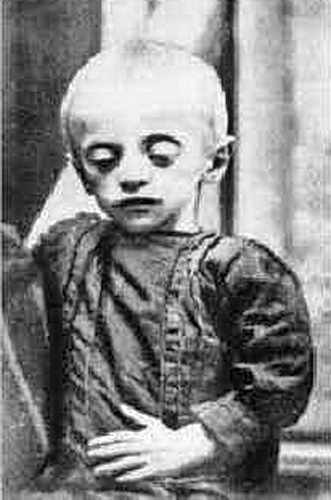
In 1932-3, the years of the great famine which followed the forced collectivisation of the land, I travelled widely in the Soviet Union, writing a book which was never published. I saw entire villages deserted, railway stations blocked by crowds of begging families, and the proverbial starving infants. . . . [T]hey were quite real, with stick-like arms, puffed up bellies and cadaverous heads. I reacted to the brutal impact of reality on illusion in a manner typical of the true believer. I was surprised and bewildered—but the elastic shock-absorbers of my [Communist] Party training began to operate at once. I had eyes to see, and a mind conditioned to explain away what they saw. This “inner censor” is more reliable and effective than any official censorship. . . .
Some Ukrainian accounts, and that of Muggeridge, who covered the holodomor for the Manchester Guardian, take the trouble to say that this mass starvation was imposed largely by Jews. Lazar M. Kaganovich is often identified as an architect of the policy. A photograph in Montefiore, Red Tsar, above, shows him personally searching a farm for concealed food. In Muggeridge’s novel Winter in Moscow (1934) he appears as Kokoshkin, “a Jew” and “Stalin’s chief lieutenant.”
In 2003 Levko Lukyanenko, the first Ukrainian ambassador to Canada, was said to have made an anti-Semitic embarrassment of himself on this subject. But see Orest Subtelny, Ukraine: A History, p. 363 (2d ed. 1994)(“Jews were . . . disproportionately prominent among the Bolsheviks, notably in their leadership, among their tax- and grain-gathering officials, and especially in the despised and feared. . . secret police [emphasis added]”); Montefiore, Red Tsar, above, p. 305 (as late as 1937, Jews accounted for only 5.7 percent of Soviet party members, but “formed a majority in the government” [emphasis added]);Yuri Slezkine, The Jewish Century, p. 254 (Princeton University Press, 2004)(the secret police was “one of the most Jewish of all Soviet institutions”); and Arno J. Mayer, Why Did the Heavens Not Darken?, p.60 (1988)(“As of the late twenties . . . [a] disproportionate number of Jews came to hold high posts in the secret police and to serve as political commissars in the armed services. They. . . were. . . appointed to high-level and conspicuous positions which called for unimpeach-able political loyalty. . . ”). Mayer, a professor emeritus of history at Princeton, is himself Jewish, and had to flee the Nazis as a refugee.
The Israeli writer Boas Evron says the leaders of the Soviet revolution were scarcely less Jewish than the Zionists. See his book Jewish State or Israeli Nation?, p. 107 (English tr., Indiana University Press, 1995): “The backgrounds of the two groups were much the same. . . . Only differences of chance and temperament caused the one [individual] to be a Zionist and the other a revolutionary socialist.”
On February 8, 1920, Winston Churchill published an article, “Zionism Versus Bolshevism: A Struggle for the Soul of the Jewish People,” in the Illustrated Sunday Herald (London), reprinted in Lenni Brenner, ed., 51 Documents: Zionist Collaboration with the Nazis, p. 23(2002). Among other things, Churchill said (pp. 25-26):
There is no need to exaggerate the part played in the creation of Bolshevism. . . by. . . international and for the most part atheistical Jews. . . . [I]t probably outweighs all others. With the notable exception of Lenin [who had a Jewish grandfather and by some accounts a Jewish wife], the major-ity of leading figures are Jews. Moreover, the principal inspiration and driving power comes from the Jewish leaders. . . . And the prominent, if not indeed the principal, part in the system of terrorism. . . has been taken by Jews. . . . The same evil prominence was obtained by Jews in the brief period of terror during which Bela Kun ruled in Hungary. The same phenomenon has been presented in Germany (especially in Bavaria), so far as this madness has been allowed to prey on the temporary prostration of the German people. (Emphasis added.)
Churchill’s views, as expressed here, resemble those of the Times of London’s correspondent in Russia, Robert Wilton. See George Gustav Telberg and Robert Wilton, The Last Days of the Romanovs (1920), esp. pp. 222-30, 391 (“[t]aken according to numbers of population, the Jews represented one in ten; among the komisars that rule Bolshevik Russia they are nine in ten—if anything, the proportion of Jews is still higher”), 392-93 and 400. The French version of the book, Les Derniers Jours des Romanofs, also published in 1920, contains a list of 556 top figures in the Bolshevik regime, classified by ethnicity. The Jewish proportion is a bit over eight in ten, including two-thirds of the leadership of the secret police. The non-Jews are divided among various small categories—Russian, Lett, Armenian, German, Georgian, etc. The list is absent from the slightly later English and American editions, but is available online. See also John F. O’Conor, The Sokolov Investigation (1971)(a translation, with commentary, of sections of Nikolai Sokolov’s Enquête judiciaire sur l’assassinat de la famille impériale Russe), especially for the comments of O’Conor and his sources on Wilton.[1]
Jews among the Bolsheviks who imposed the holodomor of 1932-33 would have relished settling scores after the 40 years of bloody pogroms that followed Czar Alexander II’s assassination in 1881—especially the still-recent massacre of 50,000 to 100,000 Jews, mostly in the Ukraine, during the Russian civil war of 1918-21. (Far greater numbers of gentiles, of course, also perished in that war; estimates run well into the millions.)
Albert S. Lindemann, Esau’s Tears, pp. 442-43 (Cambridge University Press, 1997) says that “[i]n. . . the Ukraine, the Cheka leadership was overwhelmingly Jewish”; that “the high percentage of Jews in the secret police continued well into the 1930s”; and that “[c]omparisons to the secret police in Nazi Germany have tempted many observers.
. . . [T]he extent to which both. . . prided themselves in being. . . willing to carry out the most stomach-turning atrocities in the name of an ideal. . . is striking.” Lindemann adds that:
George Leggett, the most recent and authoritative historian of the Russian secret police, speculates that the use of [non-Slavic ethnic minorities in the secret police] may have been a conscious policy, since such ‘detached elements could be better trusted not to sympathise with the repressed local population’.[2] Of course, in the Ukrainian case that population had the reputation of being especially anti-Semitic, further diminishing the potential sympathies of Jewish Chekists in dealing with it. [Citing Leggett, The Cheka, Lenin’s Political Police, p. 263(Oxford University Press, 1981).] . . . . Cheka personnel regarded themselves as a class apart . . . with a power of life or death over lesser mortals. (Emphases added.)
Yuri Slezkine’s The Jewish Century, above, illustrates the attitude of Jewish Bolsheviks toward dying Ukrainians. See Kevin MacDonald’s review of Slezkine, entitled “Stalin’s Willing Executioners?”, www.vdare. com/ misc/051105 /macdonald _stalin.htm (a much fuller version of which appears in the Occidental Quarterly, fall 2005, also available online):
Lev Kopelev, a Jewish writer who witnessed and rationalized the Ukrainian famine in which millions died horrible deaths of starvation and disease as an “historical necessity,” is quoted [on p. 230 as] saying “You mustn’t give in to debilitating pity. We are the agents of historical necessity. We are fulfilling our revolutionary duty.” On the next page, Slezkine describes the life of the largely Jewish elite in Moscow and Leningrad where they attended the theater, sent their children to the best schools, [and] had peasant women (whose families were often the victims of mass murder) for nannies. . . .
Kopelev did not offer his opinions from a distance. In his words, “I saw women and children with distended bellies, turning blue, with vacant, lifeless eyes. And corpses. . . . I saw all this and did not go out of my mind or commit suicide. . . .” Moynahan, The Russian Century, above, p. 149. Moynahan, by the way, gives a high-end estimate of the death toll as “probably. . . 14 million.” Id. at 130.
Kopelev was then in his early 20s. (Koestler was six-and-a-half years older.) Kopelev believed without question that “we were warriors on an invisible front, fighting against kulak sabotage for the grain that was needed by the country, by the five-year plan.” See vol. 1 of his memoirs, The Education of a True Believer, p. 226 (1980). He gave speeches to starving peasants at “several meetings a day,” telling them how much more the state needed their grain than they did themselves. Id. at 229. The peasants most often responded, “chop off my head”; they had nothing left to give. Id. at 231.
Fifteen years later, Kopelev himself was in the Butyrka prison in Moscow, where his fellow inmates, the writers Dmitri Panin[3] and Alexandr Solzhenitsyn, challenged his denial of his own Jewishness, and the Jewishness of the revolution. See vol. 3 of Kopelev’s memoirs, Ease My Sorrows, p. 18 (1983):
When I told Solzhenitsyn the history of the various parties and reached the Socialist Revolutionaries, recalling the leaders, Gorovits, Gershuni, Gots, he interrupted in astonishment, almost in disbelief: how can that be— Jewish surnames, when the SRs were a Russian peasant party?
* * *
Panin reproached me for the sinful rejection of my people—for not wanting to avow myself “first and foremost a Jew. . . . But it’s clearer to an outsider.” . . . Solzhenitsyn seconded him. . . . He could not agree with. . . my self-definition: “A Russian intellectual of Jewish descent.”
Notwithstanding Kopelev’s self-definition, he was incontestably Jewish for purposes of the Israeli Law of Return, which came into effect well within his lifetime.[4] Moreover, while he became a man of far more humane views as he grew older, there would be some irony in excusing his “true believer” phase as a mere youthful folly. Compare the unsparing treatment recently given Günter Grass, concerning service in the Waffen SS that involved no complicity in atrocities, and ended in his late teens.
The phrase “Stalin’s willing executioners”—with its echo of Daniel Jonah Goldhagen—is Slezkine’s (p. 130). At pp. 183-84, translating from the Russian, Slezkine quotes Ia. A. Bromberg (1931) on what Stalinism brought out in its Jewish servitors:
The convinced and unconditional opponent of the death penalty. . . , who could not, as it were, watch a chicken being killed, has been transformed outwardly into a leather-clad person with a revolver and [has], in fact, lost all human likeness. . . , standing in a Cheka basement doing “bloody but honorable revolutionary work.”
Shahak, in Three Thousand Years, above, ch. 4, traces Jewish “hatred and contempt” for peasants— “a hatred of which I know no parallel in other societies”—back to the great Ukrainian uprising of 1648-54, in which tens of thousands of “the accursed Jews” (to quote the Ukrainian Cossack leader Bohdan Khmelnytsky) were killed. Some say the number is more accurately stated in the hundreds of thousands. Heinrich Graetz says the number “may well be. . . a quarter of a million.” See his History of the Jews, vol. 5, p. 15 (1856-70, English tr., Jewish Publication Society of America ed., 1956).
The Jews at the time of the massacres were serving the Polish szlachta (nobility) and Roman Catholic clergy on their Ukrainian latifundia as arendars—toll-, rent- and tax-farmers, enforcers of corvee obligations, licensees of feudal monopolies (e.g., on banking, milling, storekeeping, and distillation and sale of alcohol), and as anti-Christian scourges who even collected tithes at the doors of the peasants’ Greek Orthodox churches and exacted fees to open those doors for weddings, christenings and funerals. They had life and death powers over the local population (the typical form of execution being impalement), and no law above them to which that population had recourse. See Graetz, vol. 5, pp. 3-6; Subtelny, pp. 123-38; Norman Davies, God’s Playground: A History of Poland, vol. 1, p. 444 (Oxford University Press, 1982); and Iwo Cyprian Pogonowski, Jews in Poland, pp. 68-79, 283 (1993). According to the last three of these sources, the arendars leased estates for terms of only two or three years and had every incentive to wring the peasants mercilessly, without regard to long-term consequences.
As Shahak points out in Three Thousand Years, chs. 3 and 5, a non-Jew, in traditional Judaism, was never “thy neighbor” for purposes of Leviticus 19:18—which was doubtless an advantage in such taxing work as an arendar’s. Shahak has much to say about rabbinical pronouncements, abundant in Israel even now, that gentile souls are closer to the souls of animals than to those of Jews. Those pronouncements are grounded, at least in part, on Ezekiel 23:20 (“[their] flesh [i.e., penises] is as the flesh of asses and [their] issue [i.e., semen] is like the issue of horses”).[5]
Norman Cantor comments in The Sacred Chain, p. 184 (1994) that “perhaps the Jews [of the arenda period] were so moved by racist contempt for the Ukrainian and Polish peasantry as to regard them as subhuman. . . . There is a parallel with the recent attitude of the West Bank Orthodox and ultra-Orthodox toward the Palestinians. Judaism can be in its Halakhic form an extremely restrictive and blinding faith.”
According to Chaim Bermant, The Jews,p. 26 (1977):
. . . [O]ne cannot see the events of [1648-49] as entirely the result of crazed fanaticism or mindless superstition. . . . [I]f the nobility were. . . the ultimate exploiters, the Jews were the visible ones and aroused the most immediate hostility. Rabbis warned that Jews were sowing a terrible harvest of hatred, but while the revenues rolled in the warnings were ignored. Moreover, the rabbis themselves were beneficiaries of the system.
Those rabbinical forebodings are also mentioned in Jacob Katz, Exclusiveness and Tolerance, p. 152 (Oxford University Press, 1961). Graetz (vol. 5, pp. 5-6) says of the Jewish arendars that they had lost “integrity and right-mindedness. . . as completely as simplicity and the sense of truth. They found pleasure and a sort of triumphant delight in deception and cheating.” He adds that they “advised the [Polish noble and ecclesiast-ical] possessors of the Cossack colonies how most completely to humiliate, oppress, torment, and ill-use [those colonies]. . . . No wonder that the enslaved Cossacks hated the Jews. . . . The Jews were not without warning what would be their lot, if these embittered enemies once got the upper hand.”
Graetz (vol. 5, p. 7) also says Khmelnytsky had personal reasons for leading the revolt: “A Jew, Zachariah Sabilenki, had played him a trick, by which he was robbed of his wife and property.” It says everything, of course, that it was possible by trickery to rob a Cossack of his wife.
The best-known contemporaneous account of the revolt is Nathan (Nata) ben Moses Hannover, Yewen Mesulah, which appeared in Venice in 1653. An English translation was published three centuries later as The Abyss of Despair (1950). Hannover was well aware of the peasants’ grievances (see pp. 27-30 of The Abyss). He described the massacres in the grimmest of terms, full of biblical allusions. He then gave the rest of his life to the holy mysteries of Lurianic cabbalism. As Graetz puts it (vol. 5, pp. 21-22), “that book of falsehoods, the Zohar, [had] declared that in the year of the world 5408 (1648) the era of redemption would dawn, and precisely in that year Sabbathai [Ze’evi] revealed himself. . . as the messianic redeemer.” Sabbathai was a manic-depressive one of whose followers, Samuel Primo, preached that “your lament and sorrow must be changed into joy.” Spinoza and other rationalists were not amused. Thousands of Sabbathai’s flock even followed him into “holy apostasy” when he converted to Islam in 1666. His own conversion was under duress; theirs was not. Graetz’s highly-readable account of the fervor (vol. 5, pp. 121-67) is similar in style and tone to Gibbon’s account of the early Christian Church.
Arendas did not disappear after the Khmelnytsky uprising. See Jewish FamilyHistory. org/ Grand_ Duchy_of_Lithuania. htm (“During the 18th century, up to 80 percent of Jewish heads of households in rural areas [of what are now Lithuania, Belarus, Ukraine and parts of Poland] were arendars, that is, holders of an arenda”). Pogonowski, p. 72, describes the return of the Jews to the Ukraine after 1648-54. Similarly, see Simon M. Dubnow, History of the Jews in Russia and Poland, vol. 1, p. 158 (1916).
Shahak (Three Thousand Years, ch. 4) says that under the arenda system, “the full weight of the Jewish religious laws against gentiles fell upon the peasants.” As to the nature of those laws, see id., ch. 5, especially under the heading “Abuse.” See also such passages as Psalm 2:8-9 (“. . . I shall give thee the heathen for thine inheritance. . . . Thou shalt break them with a rod of iron; thou shalt dash them in pieces like a potter’s vessel”); Psalm 21:8-10 (“[T]hy right hand shall find out those that hate thee. Thou shalt make them as a fiery oven in the time of thine anger: the Lord shall swallow them up. . .”); Psalm 79:6-7 (“Pour out thy wrath upon the heathen. . . [f]or they have devoured Jacob [i.e., Israel], and laid waste his dwelling place”); Jeremiah 10:25 (al-most identical); Psalm 137:8-9 (“O daughter of Babylon, who art to be destroyed, . . . [h]appy shall he be, that taketh and dasheth thy little ones against the stones”); Psalm 149:7-8; Isaiah 45:14 (“Thus saith the Lord, . . . in chains. . . they shall fall down unto [Israel]. . .”); Isaiah 60:12 (“. . .[T]he nation and kingdom that will not serve [Israel] shall perish; yea, those nations shall be utterly wasted” ); Isaiah 61:5-6 (“. . .[S]trangers shall stand and feed your flocks. . . : [Y]e shall eat the riches of the Gentiles. . .”); and of course Esther 8:11 through 10:3. As to the last, and the feast of Purim, celebrated yearly then as now, see Elliott Horowitz, Reckless Rites (Princeton University Press, 2006).
The Babylonian Talmud, cabbalist treatises, and other rabbinical writings extant during the arenda period were even harder on the gentiles, particularly Christians. See Johann Andreas Eisenmenger’s hugely controversial Entdektes Judenthum (1700), translated as Rabbinical Literature: Or the Traditions of the Jews (1748). At p. 253 of that translation we read that:
The [cabbalist] Treatise Emek hammelech, in the Part entitled Shaar shiashue hammelech, gives us the following Passage. “Our Rabbins, of Blessed Memory, have said, Ye Jews are stiled Men; because of the Soul ye have from the Supreme Man (i.e., God; whom the Cabalists call Adam Ahelion; that is, the Supreme Man). But the Nations of the World are not stiled Men, because they have not, from the Holy and Supreme Man, the Neshama (or glorious Soul). But they have the Nephesh (i.e. the Soul) from Adam Belial; that is, the malicious and unnecessary Man, called Sammael, the Supreme Devil.”
The next seven pages are filled with further such quotations. Jacob Katz, the author of Exclusiveness and Tolerance, above, anda professor of Jewish history at the Hebrew University in Jerusalem, is hardly an admirer of Eisenmenger. Very much the contrary. But in From Prejudice to Destruction, pp. 14-15, 21, passim (Harvard University Press, 1980), Katz admits some important points:
[Eisenmenger’s] book was impressive both on account of its size—some 2,120 pages in two volumes—and its tremendous erudition. . . . [He] was acquainted with all the literature a Jewish scholar of standing would have known. . . . Contrary to accusations that have been made against him, he does not falsify his sources. He quotes them in full and translates them literally. . . . The question is how did Eisenmenger arrive at so darkly a negative picture of Judaism while quoting its sources unadulteratedly?* * * There was a nucleus of truth in all his claims: the Jews lived in a world of. . . ethical duality—following different standards in their internal and external relationships. . . . (Emphases added.)[6]
The anthropologist John Hartung comments, in an essay entitled “Love Thy Neighbor: The Evolution of In-Group Morality” (1995, available online), that “the half-life and penetrance of such cultural legacies are often under-appreciated.” To illustrate Hartung’s point, “Pour out thy wrath upon our enemies” (“shfoch hamatcha al hagoyim”) is even now a prayer at the Passover seder. David M. Weinberg, director of public affairs at the Begin-Sadat Center for Strategic Studies of the Orthodox Bar Ilan University near Tel Aviv, defends it as being “part of the Haggada text for a reason: to purposefully exclude and ward off the placid, falsely high-minded thinking that has overtaken so much of today’s Western world.” See Weinberg’s essay in the Jerusalem Post, April 21, 2003 (available online). The English translation “upon our enemies”—not “upon thine enemies,” or even “upon the heathen”—is taken here directly from Weinberg. All those renditions seem interchangeable in any event. The actual word, of course, is goyim.
According to Davies (God’s Playground, vol. 1, p. 444) the oppressiveness of the Jews as arendars “provided the most important single cause of the terrible retribution that would descend on them on several occasions in the future. . . .” In 1986 the Stanford history department voted 12-11 against offering tenure to Davies, then a professor visiting from the University of London. Davies sued unsuccessfully for defamation, which suggests the tenor of the discussion. Davies is now a fellow of Wolfson College, Oxford. The queen awarded him a CMG in 2001.
Actually, the Jewish “hatred and contempt” that Shahak remarks on can be traced back to times well before the events of 1648-54. Such attitudes can be seen, for example, in medieval traditions in which Esau—portrayed in Isaiah 63 and Obadiah as one with whom God himself is at war—came to stand for agricultural Christian Europe. See Rabbi Tzvi Weinberg, “Esau-Edom: Profile of a People” (Dec. 16, 2000), at http://www .biu.ac.il/ JH/Parasha/ eng/ vayishlach/ wei.html. See also Exclusiveness and Tolerance, above, p. 6, which says that in medieval Jewish poetry Edom was synony-mous with Christianity. In Malachi 1:4 “the Lord hath indignation for ever” against Edom; see also Jeremiah 49:7-8, Lamentations 4:21-22, Ezekiel 35, and Amos 1:11.
Edom was never geographically fixed. It followed the Jews wherever they went—the nation allotted to Israel’s dehumanized twin, as ripe for righteous predation as the original Esau.[7] Edom’s presence in Europe helped rationalize the Jewish role in the immensely profitable slave trade of the eighth through the 10th centuries. European boys—mostly in the East, but in the West as well—were kidnapped and castrated by Vikings, sold to Jews, taken south down the major rivers, and sold again as eunuchs in Muslim lands from Persia to Spain. See H.R. Trevor-Roper, The Rise of Christian Europe, pp. 92-93 (1965). As Trevor-Roper points out, the words for slave and Slav come from the same root in every European language, a reminder of a commerce that has faded from memory in the West. The Arabic word for eunuch is from the same root. Some trace this trade as far back as the fifth century.[8] .
A related matter is Ashkenazic—though not Sephardic—eschatological doctrine, which in the “late antique” period followed Jeremiah 30:10-11 and 46:28 (“Fear thou not, O Jacob [i.e., Israel], my servant, saith the Lord: . . . for I will make a full end of all the nations whither I have driven thee: but I will not make a full end of thee. . .” ); and Psalms 110:6 and 94:1. See Adiel Schremer, of Bar Ilan University, “Eschatology, Violence and Suicide: An Early Rabbinic Theme and its Influence in the Middle Ages,” at research. yale.edu/ ycias/database/Files/MESV6-2.pdf: At p. 4, Schremer says:
[T]he construction of the eschatological redemption in terms of the total eradication of the nations, or at least in association with such an expectation, has a potential of shaping a violent personality and might contribute to. . . a violent mind-setting. For if one is hoping for God’s redemption soon to come, and is inspired by the idea of a total vanquish-ing of Israel’s enemies as an essential part of that redemption, one’s violent inclinations are not entirely suppressed and in a sense they are being fostered. (Emphasis added.)
Schremer’s paper was presented on May 5, 2002 at the Yale Divinity School. The reference in his title to suicide concerns the year 1096, when large numbers of Jews in the Rhineland killed themselves and their own children, siblings and parents, rather than submit to Crusaders’ efforts to convert them by force. By way of explanation, Schremer quotes Sigmund Freud: “No neurotic harbors thoughts of suicide which he has not turned back upon himself from murderous impulses against others.” Schremer cites many biblical passages and rabbinical exegeses that might feed such impulses.
For a much fuller discussion of this whole set of issues, see Israel Jacob Yuval, Two Nations in Your Womb (English tr., University of California Press, 2006). At pp. 120-21 Yuval tells of prayers that:
. . . demonstrate the abyss of hostility and hatred felt by medieval Jews toward Christians. And we have here not only hatred, but an appeal to God to kill indiscriminately and ruthlessly, alongside a vivid description of the anticipated horrors to be brought down upon the Gentiles. These pleas are formulated in a series of verbs—“swallow them, shoot them, lop them off, make them bleed, crush them, strike them, curse them, and ban them. . . destroy them, kill them, smite them. . . crush them [again], abandon them, parch them”—and in the best alphabetical tradition, the string of disasters the poet wishes for the Gentiles goes on and on.
Yuval collects an abundance of such material, from both before and after the events of 1096. In agreement with Schremer, he says (p. 123) that “we are dealing here with a comprehensive religious ideology that sees vengeance as a central component in its messianic doctrine.” He repeats (p. 125) that this vengeance was to be “against the Gentiles”—most of whom, it seems safe to say, were peasants—and that the vengeance stood “at the very heart of the messianic process.” He says tellingly (p. 134) that “the Christians were not unaware of the Jewish desire to see their destruction.”[9]
The English translation of Two Nations was followed within six months by Rabbi Dr. Ariel Toaff’s abortive publication in Italy of Pasque di Sangue: Ebrei d’Europa e omicidi rituali (Passovers of Blood: The Jews of Europe and Ritual Murder) (2007). Toaff is a professor of medieval and Renaissance history at Bar Ilan University, and son of the former chief rabbi of Rome. Another Italian Jewish academic, Sergio Luzzatto, a professor of history at the University of Turin, reviewed Toaff’s book in Il Corriere della Sera (Feb. 6, 2007). The newspaper also published extracts. According to Luzzatto, the book suggests that “from 1100 to about 1500. . . several crucifixions of Christian children really happened. . . perhaps even many,” with their blood being used by fundamentalist Ashkenazi Jews in Passover rites.
The Jewish Daily Forward (Feb. 18, 2007, available online) says “scholars have
. . . been quick to point out that Toaff is not the only medieval Jewish historian to have cast a critical eye on the version of history in which Jews emerge blameless in the face of the blood libel charge.” The Jerusalem Post (Feb 7, 2007, available online) says “Toaff refers to kabbalistic descriptions of the therapeutic uses of blood and asserts that ‘a black market flourished on both sides of the Alps, with Jewish merchants selling human blood, complete with rabbinic certification of the product—kosher blood.’” Toaff told Ha’aretz (Feb. 12, 2007, available online) that “over many dozens of pages I proved the centrality of blood on Passover. Based on many sermons, I concluded that blood was used, espe-cially by Ashkenazi Jews, and that there was a belief in the special curative powers of children’s blood.” Toaff added that “the rabbis permitted [its use] both because the blood was already dried,” and because it was “an accepted custom that took on the force of law.”
Sergio Luzzatto called Toaff’s book “courageous” and “magnificent.” But then, in Toaff’s words, his work of seven years “was torn apart by the Italian rabbis with just a few phone calls.” Dr. Amos Luzzatto, former president of the Union of Italian Jewish Communities—not to be confused with Sergio—told the Jerusalem Post (Feb. 7)that “even if [Toaff] should manage to prove that a deviant sect existed for centuries. . . clearly it could never be identified as a Jewish group, or as part of a Jewish community.” Toaff said “I will not give up my devotion to the truth and academic freedom even if the world crucifies me” (Ha’aretz, Feb. 12). Nonetheless, he denied he had ever meant to allege ritual murder—despite the title of his book, and despite his having told La Stampa (according to AmericanThinker.com)that:
My research has shown that in the Middle Ages, a group of fundamentalist Jews did not respect the biblical prohibition [against the consumption of blood]. . . . It is just one group of Jews, who belonged to the communities that suffered the severest persecutions during the Crusades. From this trauma came a passion for revenge that in some cases led to responses, among them ritual murder of Christian children. (Emphasis added.)
Toaff withdrew the book to revise it, after some 3,000 copies had been sold, and donated his income from the book to the Anti-Defamation League. On Feb. 11, the Jerusalem Post reported that Toaff “has been prevented from seeing or even contacting his [91-year-old] father.” In its Feb. 22 online edition, the Chronicle of Higher Educa-tion noted the obvious—that Toaff’s “public statements varied widely as the controversy played out.” Israel Shamir, in a thorough analysis (IsraelShamir.net), says “Toaff came under strong community pressure: he was about to find himself at 65, on the street, probably without pension, without old friends and students, ostracized and excommuni-cated. Probably his life was threatened as well: Jews employ professional secret killers to deal with such nuisances.” For more such commentary, see DannySteinberg.blogspot. com. How all this bodes for revision of Toaff’s book remains to be seen, assuming it ever reappears.[10]
The ethnocentric hostility of the Jews—consistently commented on by the peoples who have encountered them over the millennia—can be traced ultimately to the origins of Judaism as set forth in the Torah, e.g., Genesis 9:25 (“Cursed be Canaan; a servant of servants shall he be unto his brethren”);Exodus 17:14-16 and 34:12-13 ; Numbers 24:8 (“God. . . shall eat up the nations his enemies, and shall break their bones, and pierce them through with his arrows”), 25:6-13 (wherein God commends Phineas for his initia-tive in running a javelin through both parties to a marriage of Jew and gentile), 31:7-19 and 33:50-56; and Deuteronomy 2:33-35 (“[on God’s command] we. . . utterly destroyed the men, and the women, and the little ones, of every city, we left none to remain”), 3:4-7, 7:1-5 (“thou shalt. . . utterly destroy them”), 7:14-26 (“thine eye shall have no pity”), 20:10-17 (“thou shalt save alive nothing that breatheth”) and 25:19. Disdain for ordinary labor—to be performed by Esau and Edom, but to be exploited by Israel—appears as early as Genesis 25:23-27, as discussed in note vii below.
Ethnocentric hostility has lent itself to Jewish tax-farming. This can be traced back to very early times, and has sometimes involved copious use of deadly force, put at the disposal of the tax-farmers by their noble clients. See Flavius Josephus, The Antiquities of the Jews, bk. 12, ch. 4 (1st c.), available online (Syria violently stripped to its “bones” for Ptolemy III); and Elias Bickerman, The Jews in the Greek Age, p. 120 (Harvard University Press, 1988).
See also Rabbi Simeon’s lumping of gentiles with serpents, above; Cornelius Tacitus, The Histories, bk. 5.5 (c. 109 A.D.) (“[the Jews] regard the rest of mankind with all the hatred of enemies”); Gibbon, ch. 15 (“the[ir] sullen obstinacy. . . and unsocial manners seemed to mark them out a distinct species of men, who boldly professed, or who faintly disguised, their implacable hatred to the rest of humankind”); and Emilio Gabba, “The Growth of Anti-Judaism or the Greek Attitude Toward the Jews,” in W.D. Davies and Louis Finkelstein, eds., The Cambridge History of Judaism, vol. 2(Cam-bridge University Press, 1990). At p. 629 Gabba attributes to Hecataeus of Abdera (early 3d c. B.C.) an observation about the hostility of the Jews. Gabba excuses that hostility, saying the Jews’ “misanthropic reserve” was understandable in light of the exodus from Egypt. But the exodus—thought by Hecataeus to have been an expulsion, and by Tacitus to have been an expulsion of lepers—was perhaps a thousand years past even when Hecataeus wrote. At p. 645 Gabba cites Posidonius (134 B.C.) on the advice given to his contemporary, King Antiochus Sidetes, to destroy the Jews, “for they alone among all peoples refused all relations with other races and saw everyone as their enemy. . . .”
Almost identical advice was given to King Ahasuerus (Xerxes I, 485-465 B.C.) in Esther 3:8-9. Some two-and-a-half millennia after Ahasuerus, the Jews still celebrate on their most joyous holiday the vengeance he allowed them: “sl[aughter] of their foes seventy and five thousand,” including “both little ones and women,” and hanging not just of the man who gave the advice, but of all ten of his sons. It was an occasion of “light, and. . . joy, and honour,” and of “gladness and feasting.” Id.,8:11-17, 9:13-28.
Martin Luther’s comments on this story, in The Jews and Their Lies (1543), fit seamlessly with Yuval’s account of “a comprehensive [Jewish] religious ideology that sees vengeance as a central component in its messianic doctrine,” and Schremer’s account of Jewish hopes for “eschatological redemption in terms of the total eradication of the nations”:
Oh how [the Jews] love the Book of Esther, which so nicely agrees with their bloodthirsty, revengeful and murderous desire and hope. The sun never did shine on a more bloodthirsty and revengeful people than they, who imagine themselves to be the people of God, and who desire to, and think they must, murder and crush the heathen. And the foremost undertaking which they expect of their Messiah is that he should slay and murder the whole world with the sword.
This passage—indeed, the whole 64-page essay—is often cited as evidence of Luther’s pathological anti-Semitism, but Yuval and Schremer show that at least on this point he knew whereof he spoke. As Yuval says, “the Christians were not unaware of the Jewish desire to see their destruction.” Luther’s comments also fit with the descriptions of Jewish arendars given above—men who “found pleasure and a sort of triumphant delight in deception and cheating” (Graetz); who sowed “a terrible harvest of hatred” (Bermant); who may have been “so moved by racist contempt for the Ukrainian and Polish peasantry as to regard them as subhuman” (Cantor); and whose oppressiveness “provided the most important single cause of the terrible retribution that would descend on [the Jews] on several occasions in the future. . .” (Davies).
Even in the 21st century, Israeli children are taught to sing “The Whole World is Against Us”(“Ha’olam Ku’lo heg’denu”). The second-century Rabbi Simeon postu-lated “a law that Esau hates Jacob”—and almost two millennia later that law remains a commonplace, sometimes thought adequate to explain the world. We have not only David M. Weinberg’s defense of the “shfoch hamatcha” prayer, but even Rabbi Meir Y. Soloveichik, “The Virtue of Hate,” First Things, Feb. 2003 (available online)(“When hate is appropriate, then it is not only virtuous, but essential for Jewish well-being”). Soloveichik is not a fringe figure. He is a member of an exceedingly eminent Orthodox rabbinical family. When he wrote the article he was resident scholar at the Jewish Center in Manhattan and a Beren fellow at Yeshiva University, and was studying the philosophy of religion at the Yale Divinity School.
Note the words “essential for Jewish well-being.” The “virtue of hate” seems to come of a positive need to be hated. The widely-published Rabbi Dr. Dan Cohn-Sherbok, professor of Jewish history at the University of Wales (Lampeter) and author of The Paradox of Anti-Semitism (2006), says in an interview with the Independent (U.K.), March 19, 2006 (available online) that: “Jews need enemies in order to survive. . . . [I]n the absence of Jew-hatred, Judaism is undergoing a slow death. . . . We want to be loved, and we want Judaism to survive intact. . . . [T]hese are incompatible desires. . . . Why do we endure? Because we’re hated.” (Emphases added.) Cohn-Sherbok says of a founder of Zionism, Theodor Herzl: “He warned that if our Christian hosts were to leave us in peace for two generations, the Jews would merge entirely into surrounding races.” Id. Herzl also wrote in his conclusion to Der Judenstaat (1896): “Universal brotherhood is not even a beautiful dream. Antagonism is essential to man’s greatest efforts.”
In his book (p. 209) Cohn-Sherbok says that “in the past ultra-Orthodox Jewish leaders were profoundly aware of this dynamic.” One of his examples is Schneur Zalman of Lyady, the first Lubavitch Rebbe and author of Ha’tanya (1796), the fundamental book of the Habbad movement, whose first chapter famously concludes by saying gentile souls “contain no good whatever.”[11] In 1812, Zalman worked with the anti-Semitic Czar Alexander I to defeat Napoleon. He feared Napoleon would liberate the Jews, who might expect to benefit materially—although that’s a much-disputed calculation—but whose souls would be lost to assimilation and intermarriage.
Similarly, according to Ha’aretz, June 3, 2004 (available online), “in the mid-19th century, Rabbi [Samson Raphael] Hirsch, the leader of Germany’s Orthodox Jews, wrote that anti-Semitism is the tool through which the God of Israel preserves his people.” In 1958, Rabbi Dr. Nahum Goldmann, then president of the World Jewish Congress, com-plained that the “current decline of overt anti-Semitism might constitute a new danger to Jewish survival,” one that “has had a very negative effect on our internal life.” In 1957, Leo Pfeffer, then counsel to the same organization, said much the same. As to both, see Alfred M. Lilienthal, The Zionist Connection II, p. 412 (1982). See also Charles E. Silberman, A Certain People, p. 165 (1985):
“For all that we are preoccupied by the damage once done to us by our enemies, we are still more concerned by the curse of friendship we nowencounter,” Leonard Fein, editor and publisher of Moment magazine, told the Conference of Jewish Communal Service in 1980. . . . “Deep down—and sometimes not so very deep—we still believe that we depended on the pogroms and persecutions to keep us a people, that we have not the fiber to withstand the lures of a genuinely open society.” (Emphasis added.)
Hannah Arendt says of this whole line of thinking, in The Origins of Totali-tarianism, p. 7 (1973 ed.), that “. . . eternal anti-Semitism would imply an eternal guarantee of Jewish [corporate] existence. This superstition is a secularized travesty of the idea of eternity inherent in a faith in chosenness.”
It follows from this “superstition” (or psychological insight) that where anti-Semitism is inadequate to prevent an erosion of Jewish identity, it has to be fabricated or provoked. A seemingly encyclopedic survey of such fabrication—at least as it’s appeared in recent years—can be found in Norman Finkelstein, Beyond Chutzpah, pp. 21-85(University of California Press, 2005).[12] As to the other technique, provocation, see Yuval, Two Nations; Shahak, Three Thousand Years; Lindemann, Esau’s Tears; some of the other material discussed above; and the private diary of Moshe Sharett, then prime minister of Israel, for May 26, 1955.
That diary entry records the view of Sharett’s colleague Moshe Dayan that only by a strategy of endless “provocation and revenge” toward its neighbors can Israel survive. Israel, says Sharett (paraphrasing Dayan), “must. . . invent dangers” to “keep its morale high and to retain its moral tension.” Sharett even quotes David Ben Gurion: “It would be worth while to pay an Arab a million pounds to start a war.” See the extended quotation from Sharett’s diary in Livia Rokach, Israel’s Sacred Terrorism, p. 44 (1980) (available online; emphasis in original). Rokach, whose father was Sharett’s minister of the Interior, says(id., p. 8) that by the mid ‘50s, if not before:
Terrorism and “revenge” were. . . to be glorified as the “moral . . . and even sacred” values of Israeli society. . . . [T]he military symbol was now Unit 101, led by Arik Sharon. . . . The lives of Jewish victims. . . had to be sacrificed to create provocations justifying subsequent reprisals. . . . A hammering, daily propaganda, controlled by the censors, was directed to feed the Israeli population with images of the monstrosity of the Enemy. (Emphasis added.)
Meanwhile, she says, Israel’s leaders never believed in any external threat to Israel’s survival. What they wanted was regional hegemony, and of course internal cohesion. In 1984, after her book had ceased to be news, Rokach was found dead in a Rome hotel room.
Boas Evron makes some of the same points as Rokach, in Jewish State or Israeli Nation?, above. At p. 251 he says: “In the absence of a positive national bond, Ben Gurion deliberately sought to base the national consciousness on the negative foundation of terror and nightmare. . . .” According to two books by the Mossad defector Victor Ostrovsky, By Way of Deception (1990) and The Other Side of Deception (1994), Mossad doctrine is squarely in accord with the views of Dayan and Ben Gurion, as recorded by Sharett and amplified by Rokach and Evron.[13]
For more on hostile solidarity as an essential element of Judaism, see three books by Kevin MacDonald, A People That Shall Dwell Alone (1994), Separation and its Discontents (1998),and The Culture of Critique (1998); and John Hartung’s essay “Love Thy Neighbor,” above. Hartung begins with an epigraph from Blaise Pascal’s Pensees (1670): “Men never do evil so completely and cheerfully as when they do it from religious conviction.” MacDonald and Hartung see Judaism as an economic strategy for competing with host populations, from whom the sharpest self-differentiation has to be maintained. One might infer from their work—as from such passages as Deuteronomy 7:14-26—a system designed to suppress the recognition of fellow humanity across ethnic and religious lines, a system still functioning millennia after its inception. Of course, any such analysis is taken as purest anti-Semitism, an occasion of “terror and nightmare” call-ing for (of all things) hostile solidarity.[14]
See also Moses Hadas, Hellenistic Culture: Fusion and Diffusion,chs. 7 and 20 (Columbia University Press, 1959) as to the influence, via Plato, of closed, totalitarian Sparta on Judaism as far back as the Maccabean period (142-63 B.C.).[15]
Then there’s the widely-reprinted article that Rabbi Israel Hess, campus rabbi at Bar Ilan University, wrote for its student magazine, Bat Kol, entitled “Genocide: A Commandment of the Torah” (Feb. 26, 1980). Rabbi Hess took as his text Deuteronomy 25:17-19 (“[T]hou shalt blot out the remembrance of Amalek from under heaven; thou shalt not forget [to do] it”). Amalek, he said, is any people that declares war on Israel. The Israeli state rabbinate has never taken direct issue with Rabbi Hess—as it has for example with Reform Judaism.[16] In 2001, Rabbi Ovadiah Yosef, formerly Sephardi chief rabbi, and founder and leader of Israel’s third largest political party, Shas, called sweepingly for “extermination of the Arabs,” saying “it is forbidden to be merciful to them.” Shas M.K. Eli Yishay (later Ehud Olmert’s vice prime minister) said Rabbi Yosef was merely echoing Ariel Sharon. BBC News, April 10 and 11, 2001, available online.
Desire to escape the Jewish condition—with its ethical double standards, its “virtue of hate,” its abhorrence of “the curse of friendship,” its obsession with “total eradication of the nations,” and the consequent esotericism of the rabbinical literature[17]—motivated those early secular Zionists who longed for direct labor on the land and disparaged intellectual and commercial occupations reminiscent of the arendar role. Lenni Brenner discusses such attitudes in Zionism in the Age of the Dictators, ch. 2 (1983), available online. See also Slezkine, The Jewish Century, above, pp. 327-28. That group of Zionists hoped to make Israel a “normal” nation.
But their religious successors, returning to Judaism’s roots, have countered that normality is precisely what Israel can never have, because of its unique relationship with God. See Shahak and Mezvinsky, Jewish Fundamentalism, above, p. 71:
The Gush Emunim [Bloc of the Faithful] argument is that secular Zionists measured. . . “normality” by applying non-Jewish standards that are satan-ic. . . . [According to] one of the group’s leaders, Rabbi [Shlomo] Avner: “While God requires. . . normal nations to abide by abstract codes of justice and righteousness, such laws do not apply to Jews.” . . . Relying upon the Code of Maimonides and the Halakha, Rabbi [Israel] Ariel [of Gush Emunim] stated: “A Jew who kill[s] a non-Jew is exempt from human judgment and has not violated the [religious] prohibition of murder.”[18] (Emphases added.)
On the other hand Shahak and Mezvinsky say (id.) that “the murder of a Jew, particularly by a non-Jew, is in Jewish law the worst possible crime.”
Such contemptuous attitudes and double standards were very much alive at the time of the holodomor. In 1932, the first year of the famine, the great Eastern European Hebrew poet Chaim Nachman Bialik published the poem “My Father,” which Shahak (Three Thousand Years, ch. 4 n.9) says is still “taught in all Israeli schools.” The poem depicts Bialik’s “righteous and upright” father dispensing vodka in a “den of pigs like men,” to Slavic peasants “rolling in vomit” with “faces of monstrous corruption.” Bialik calls them “scorpions” for good measure. The father’s “whispered syllables,” mean-while, audible only to his adoring son, are “pure prayer and law, the words of the living God.” The poem nowhere acknowledges the common complaint that the Jews encouraged Slavic alcoholism, which brought in revenue, exposed peasants’ remaining assets to foreclosure, and made them easier to control.
The poem is missing from Bialik’s supposedly Complete Poetic Works (1948) published in English 14 years after his death. That brings us back to Shahak and Mezvinsky’s point, above, about books and translations that falsify by omission.
A related point: A search of the Library of Congress catalog under the keyword “arenda” brings up 37 apparently relevant items, not one of which is in English. By way of comparison, a search under the combination of “United States” and “slavery” brings up more than 10,000. A search under “Ukrainian famine” brings up all of ten items. A search under “holocaust” brings up more than 10,000.
More evidence of ineradicable attitudes (“. . . I shall give thee the heathen for thine inheritance. . . . Thou shalt break them with a rod of iron; thou shalt dash them in pieces like a potter’s vessel”) was recently seen on Israeli television in the series “The Oligarchs.” The series was most definitely not shown in the U.S. Uri Avnery describes it in an article entitled “How the Virgin Became a Whore” (2004), widely available online:
Some of its episodes are simply unbelievable—or would have been, if they had not come straight from the horses’ mouths: the heroes of the story, who gleefully boast about their despicable exploits. The series was produced by Israeli immigrants from Russia.
* * *
[The oligarchs] exploited the disintegration of the Soviet system to loot the treasures of the state and to amass plunder amounting to hundreds of billions of dollars. In order to safeguard the perpetuation of their business, they took control of the state. Six of the seven are Jews. . . . [Boris] Berezovsky boasts that he caused the war in Chechnya, in which tens of thousands have been killed and a whole country devastated. He was interested in the mineral resources and a prospective [oil] pipeline there.
. . . In the end there was a reaction: Vladimir Putin, the taciturn and tough ex-KGB operative, assumed power, took control of the media, put one of the oligarchs (Mikhail Khodorkovsky) in prison, [and] caused the others to flee (Berezovsky is in England, Vladimir Gusinsky is in Israel, [and] another, Mikhail Chernoy, is assumed to be hiding here [in Israel]).
For more extensive, annotated discussion of the same series, see Alison Weir, “Russia, Israel and Media Omissions,” CounterPunch.com, Feb. 17, 2005. Weir’s article is also posted at IfAmericansKnew.org. [19]
In short, then, the history of Jewish relations with Slavic peasants—together with the much longer history of Jewish attitudes toward “the nations”—has enormous rele-vance in explaining why hereditarily-Jewish Bolsheviks in the 1930s, using supposedly scientific Marxist terminology, defined the Ukrainian peasantry as the “class enemy” and carried out a policy of genocidal starvation. In The Jewish Experience, p. 364 (1996), Norman Cantor freely admits as much:
The Bolshevik Revolution and some of its aftermath represented, from one perspective, Jewish revenge. . . . During the heyday of the Cold War, American Jewish publicists spent a lot of time denying that—as 1930s anti-Semites claimed—Jews played a disproportionately important role in Soviet and world Communism. The truth is until the early 1950s Jews did play such a role, and there is nothing to be ashamed of. In time Jews will learn to take pride in the record of the Jewish Communists in the Soviet Union and elsewhere. It was a species of striking back. (Emphases added.)
These words are part of Cantor’s introduction to a chapter by the Russian Jewish writer Arkady Vaksberg, entitled “Stalin’s Jews.” It is most unlikely that Cantor, a professor of history at New York University and a former Rhodes scholar, wrote in ignorance of the scope of Soviet state homicide. Leaving aside issues of pride, shame, and ethnic or religious loyalties, this passage puts Cantor in full agreement with Churchill, Robert Wilton, and Ambassador Levko Lukyanenko, all above.
Edwin Schoonmaker, Democracy and World Dominion, pp. 211-12 (1939) confirms Cantor’s point:
Fifteen years after the Bolshevist Revolution was launched to carry out the Marxist program, the editor of the American Hebrew could write: “According to such information as the writer could secure while in Russia a few weeks ago, not one Jewish synagogue has been torn down, as have hundreds—perhaps thousands—of the Greek Catholic churches. . . .” (American Hebrew, Nov. 18, 1932, page 12.) Apostate Jews, leading a revolution that was to destroy religion as the “opiate of the people,” had somehow spared the synagogues of Russia. (Emphases added.)
The “Greek Catholic” church is the Ukrainian Greek Catholic (or “Uniate”) church formed in 1596 under the rule of Roman Catholic Poland. The rite is Greek Orthodox, but it recognizes the pope. At the time of the Bolshevik Revolution it included much of the peasantry in the western Ukraine. Acting out such verses as 1 Samuel 15:3 —“cultural legacies” as Hartung would call them — the Bolsheviks destroyed communi-cants and buildings alike. Schoonmaker goes on to say that while the Bolsheviks, as atheists, permitted any amount of speech hostile to religion, they defined Jewishness in terms of ethnicity rather than religion, banned ethnic slurs, and punished expressions of anti-Semitism on that basis.
Thus the long cycle of violence: (a) throughout the middle ages—both before and after the Crusades—the Ashkenazim prayed for divine extermination of the goyim,as described in Two Nations; (b) the attitudes reflected in such prayers were reflected as well in speech, conduct and demeanor, plainly intelligible to the goyim themselves, as described both in Two Nations and at greater length in Three Thousand Years, to say nothing of Luther and Eisenmenger; (c) those attitudes were acted out in the sale of Christian children as eunuchs, and may later have been acted out in ritual murders, as alleged in Pasque di Sangue; (d) Jews as arendars, in Chaim Bermant’s words, “sow[ed] a terrible harvest of hatred”; (e) peasants responded by killing Jews in great numbers in revolts and pogroms over the centuries; and (f) Jews as Bolsheviks ultimately responded, in Cantor’s phrase, with “Jewish revenge.” That revenge consisted of mass murder on a scale far beyond any theretofore imposed on Jews by Christians, or on the civilians of any European nation by their own government.
Apart from war as such, there has there been no terror on that scale since, either, at least in Europe. (Asia, and particularly Asian Communism, is another matter.) See the numerical estimates in The Black Book of Communism, p. 4, and in Harvest of Sorrow, p. 306. The former set of estimates puts the overall number of deaths from Communist “crimes against civilians” in the Soviet Union and Eastern Europe at 21 million. Martin Malia of the University of California at Berkeley, in his foreword to the Black Book, p. xx, says “. . . it is at last becoming clear that our current qualitative judgments are scandalously out of line with the [20th] century’s real balance sheet of political crime.”
There has been little Jewish willingness to accept responsibility for any part of the long cycle. Cantor “learn[ed] to take pride in. . . a species of striking back,” and Shahak (Three Thousand Years, ch. 4) says of the Khmelnytsky rebellion that:
This typical peasant uprising against extreme oppression, an uprising accompanied not only by massacres committed by the rebels but also by even more horrible atrocities and “counter-terror” of the Polish magnates’ private armies, has remained emblazoned in the consciousness of east-European Jews to this very day—not, however, as a peasant uprising, a revolt of the oppressed, of the real wretched of the earth, nor even as a vengeance visited upon all the servants of the Polish nobility, but as an act of gratuitous antisemitism directed against Jews as such.
An example demonstrating Shahak’s point is Louis Finkelstein, ed., The Jews: Their History, Culture and Religion (3d ed., 2 vol., 1960), which tells of the massacres of 1648-49 (pp. 250-51, 388-89), but says nothing of the arenda system. Finkelstein’s index has no entry under that word. Nor, for that matter, does Geoffrey Wigoder, ed., The New Encyclopedia of Judaism (2d. ed., New York University Press, 2002). The essay on Khmelnytsky in the Encyclopedia Judaica (1972), ignoring even Graetz and Nata Hannover, actually denies the existence of evidence the Jewish arendars were oppressive. None of these recent works, of course, says so much as a word about the Ukrainian famine of 1932-33 or its perpetrators.
In The Sacred Chain, pp. 14-16, passim, Cantor says that “. . . rabbinical Judaism prefers silence on history,” and that after the intense historical emphasis of the Bible:
Judaism [swung] radically to become a religion without history by not later than the second century A.D. . . . By and large the Jewish blackout on historical writing continued into the nineteenth century. . . . What was not blotted out was diminished and narcotized into a recital of unprovoked victimization [of Jews]. . . .
To similar effect, see Three Thousand Years, ch. 2, esp. notes 8-14 and accom-panying text; and Samuel Grayzel’s preface to The Abyss, above, at p. ix. Even today, Cantor says (p. 15), “realistic, truth-telling history of the Jews is not welcome in the ruling circles of the American and Israeli Jewish communities, among the rabbis, the billionaire patriarchs. . . and the prominent politicians.”[20]
See also chapter 8 of Separation and Its Discontents, above (“Self Deception as an Aspect of Judaism as a Group Evolutionary Strategy”). MacDonald begins that chapter with a quotation from Hannah Arendt, The Origins of Totalitarianism, above, pp. vii-viii. Arendt notes the “strong polemical and apologetic bias” in Jewish historiography (a matter that also interests Cantor, and especially Shahak), and then says:
When [the] Jewish tradition of an often violent antagonism to Christians and Gentiles came to light “the general Jewish public was not only outraged but genuinely astonished,” so well had its spokesmen succeeded in convincing themselves and everybody else of the non-fact that Jewish separateness was due exclusively to Gentile hostility and lack of enlightenment. . . . [T]his self-deceiving theory. . . actually amounted to a prolongation and modernization of the old myth of chosenness. . . .[21]
Arendt’s interior quotation in this passage is from Jacob Katz, Exclusiveness and Tolerance, above, p. 196. Compare chs. 11 (“Ghetto Segregation”) and 12 (“The Attitude of Estrangement”) in that book. Such self-persuasion as to non-facts may be why Guenter Lewy, above, can argue that the Gypsies brought down genocidal wrath on their own heads with their moral and ethical double standards. Lewy has apparently repressed all awareness that Judaism has, in Katz’s words, its own “ethical duality—following different standards in . . . internal and external relationships.”[22]
The preference for silence about Jewish history may be also be a corollary of din moser, the law—rooted in Deuteronomy 17:8-12 and openly enforced in the Pale of Settlement through most of the 19th century—under which those suspected of betraying Jewish information to gentile authorities were subject to death without notice, by orderof the rabbis and other community leaders. See Jewish Fundamentalism in Israel, above, pp. 140-47. At pp. 146-47 Shahak and Mezvinsky say that:
The new Israeli historians have presented evidence showing that until the 1880s the killings of Jewish informers by Jews in the Tsarist Empire were numerous. . . . [T]he writer Shaul Ginzberg. . . wrote in his autobiography that during the nineteenth century hundreds of Jewish informers were drowned in the Dnieper, the largest river in the “Pale.” These informers were charged and convicted under the law of the informers simply because they were suspected of informing the authorities about something. * * * [A] Jewish informer was condemned to death in secret without being able to say anything in his own defense. This mode of execution was employed for hundreds of years until the recent time.
Again, as Hartung says, “the half-life and penetrance of such cultural legacies are often under-appreciated.” Shahak and Mezvinsky discuss din moser in the context of Prime MinisterYitzhak Rabin’s assassination by a religious zealot, heartily encouraged by Orthodox rabbis, only a few years short of the 21st century. Also as to the Rabin case, see Allan C. Brownfeld, “Growth of Religious Extremism in Israel,” Washington Report on Middle East Affairs, Aug.-Sept. 2000, available online. Din moser may have some-thing to do with the enormous antipathy with which some regard Shahak himself, and with the death of Livia Rokach. It may also illuminate some of the matters discussed in the endnotes below.
While truth-telling is silenced, ad hominem vilification is amplified. David Horowitz of FrontPageMag. com, to pick just one example, calls former President Jimmy Carter a “Jew-hater, genocide-enabler and liar” for saying Israel imposes “apartheid” on the Palestinians in the West Bank. He also accuses Carter of “blood libel.” But Horowitz surely knows that Ariel Sharon told former Italian Premier Massimo D’Alema—at length, according to D’Alema—that Israel means to force the Palestinians into “Bantu-stans.” Ha’aretz, May 13, 2003 (available online).
See also the 24-page Report of the [UN] Special Rapporteur on the Situation of Human Rights in the Palestinian Territories Occupied Since 1967, John Dugard (advance edited version, Jan. 29, 2007, available online). Dugard is a South African lawyer well acquainted with apartheid in his own country. He reports a “humanitarian crisis” and Israeli “war crimes” (p.3); “particularly vicious military action” against Palestinian civilians (p. 8); killing of “members of the Palestinian Red Crescent ambulance services” (p. 11); and Israeli “viola[tion of] the most fundamental rules if international humanitarian law” (id.). At p. 20, he asks: “Can it seriously be denied that the purpose. . . is to establish and maintain domination by one racial group (Jews) over another racial group (Palestinians) and systematically oppress them?”
Shulamit Aloni (formerly Israeli minister of Education) says, in “Indeed There is Apartheid in Israel,” Jan. 5, 2007 (available online), that:
On one occasion I witnessed an encounter between a [Palestinian] driver and [an Israeli] soldier who was taking down the details before confiscating the vehicle and sending its owner away. “Why?” I asked the soldier. “It’s an order—this is a Jews-only road,” he replied. I inquired as to where was the sign. . . instructing [non-Jewish] drivers not to use it. His answer was. . .: “It is his responsibility to know it, and besides, what do you want us to do, put up a sign. . . and let some anti-Semitic reporter. . . take a photo so he can show the world that apartheid exists here?” (Emphases added.)
Horowitz’s invective is aimed, of course, not so much at Carter as at politicians and others still worried about their jobs, not to mention university presidents worried about fundraising. It’s meant to intimidate—which it does—and its style is not new. Esau’s Tears, above, reports complaints of such “intellectual terrorism” (Franz Mehring’s words) from the early 1880s. See p. 136; compare pp. 138-39, 193. There’s no reason to suppose such character-assassination began only then, or that it’s unrelated to the essential, unifying cycle of provocation and revenge discussed above. Current Israeli treatment of Palestinians likewise seems part of that cycle, as does Jewish treatment of Slavs in whatever period.
The Nazis, no less than the Bolsheviks, regarded Ukrainian peasants with murderous contempt, an attitude not traditional in the army general staff, but brought to exceedingly full flower in the SS. See, e.g., H.R. Trevor-Roper, The Last Days of Hitler, pp. 5-8 (1947). Arendt says the Nazi plan, on which time blessedly ran out, “aimed at the extermination of the Polish and Ukrainian people, . . . 170 million Russians [and] the intelligentsia of Western Europe.” The Origins of Totalitarianism, above, p. 411. The Ukrainians learned what the Nazis meant to do with them after they initially greeted the Wehrmacht as liberators in 1941—a greeting the holodomor goes far to explain.
It would be interesting to know what the Nazis made of the holodomor, which was still very much in progress when they came to power in 1933. They surely knew about it. The German intelligence services, even on the unlikely assumption that they had no sources of their own, could hardly have missed the story in the British press as reported by Muggeridge, by former Prime Minister David Lloyd George’s heroic protégé Gareth Jones, and by A.T. Cholerton of the News-Telegraph and the Sunday Times; in the American press as reported by Lyons, by Ralph Barnes of the New York Herald-Tribune, by W.H. Chamberlin of the Christian Science Monitor, by William Stoneman of the Chicago Daily News, by Harry Lang and Richard M. Sanger of the New York Journal, and by Adam J. Tawdul of the New York American; in the French press as reported by Suzanne Bertillon of Le Matin; and in the German press as reported by the liberal (and Jewish) Paul Scheffer of the Berliner Tageblatt, and by Otto Auhagen in the scholarly journal Osteuropa, VII (Aug. 1932). Even at that early date, Auhagen said Ukrainian peasants were reduced to eating the cadavers of horses, from which they contracted infectious diseases.
The Nazis could hardly have failed to notice, moreover, when Theodor Cardinal Innitzer of Vienna called in August 1933 for relief efforts, stating that the Ukrainian famine was claiming lives “likely. . . numbered. . . by the millions” and driving those still alive to infanticide and cannibalism. See the New York Times, Aug. 20, 1933, reporting both Innitzer’s charge and the official denial (“in the Soviet Union we have neither cannibals nor cardinals”). The next day, the Times added Duranty’s own denial.
Other sources can be found by searching on the combination of “Innitzer” and “Ukraine” and “famine.” Also, P.C. Hiebert and the Rev. Charles H. Hagus tried to organize relief efforts on behalf of the German Mennonite community. None of the proposed relief operations had any significant success.
Most likely, the lesson the Nazis drew was how safe, easy, even acceptable it was to murder whole populations. That was demonstrably Hitler’s own conclusion about the early-20th-century Armenian genocide at the hands of the Turks (“Who speaks any more [of that]?”)[23] and the annihilation of the American Indians (“Treat them like redskins”). Likewise, the Zionist leader Vladimir Jabotinsky actually spoke of the “good name” Hitler himself had supposedly given to forced “mass migrations.”
Just before his death in 1940, Jabotinsky justified “transferring” the Palestinian people out of their homes on the ground that “the world has become accustomed to
the idea of mass migrations and has become fond of them. . . . Hitler—as odious as he is to us—has given this idea a good name in the world.” Tom Segev, One Palestine, Complete, pp. 406-07 (2000); see generally Nur Masalha, Expulsion of the Palestinians: The Concept of “Transfer” in Zionist Political Thought, 1882-1948 (1992).Twenty-one years after Jabotinsky’s back-handed compliment to Hitler, Adolf Eichmann was put on trial in Israel. Two of the counts on which he was convicted alleged mass forcible expulsion of people—non-Jews at that—from their homes. Those counts (nos. 9 and 10) both carried the death penalty. Hannah Arendt, Eichmann in Jerusalem, p. 245 (1963).
Israel is now concerned both to cultivate its relations with Turkey and to preserve the claim of Jewish exclusivity for “the” Holocaust (capital “H”). There is also a Jewish tradition in which the Armenians, for obscure reasons, are equated with the Amalekites; see Reckless Rites, above, pp. 10, 122-25. Accordingly Israel not only maintains a diplomatic silence about the slaughter of the Armenians but also lobbies against its commemoration in the U.S. See Larry Derfner in the Jerusalem Post, April 21, 2005 (“[O]n the subject of the Armenian genocide, Israel and some U.S. Jewish organizations, notably the American Jewish Committee, have for many years acted aggressively as silencers”); and Jon Wiener in the Nation, July 12, 1999 (“Lucy Dawidowicz, a leading Holocaust historian, argued that the Turks had ‘a rational reason’ for killing Armenians, unlike the Germans, who had no rational reason for killing Jews”).
Note carefully Dawidowicz’s “rational reason” for killing 1.5 million human beings; Kopelev’s “historical necessity” and “revolutionary duty” to kill 7 (or perhaps even 10) million; Koestler’s “mind conditioned to explain away what [he] saw”; and Cantor’s mature judgment that “there is nothing to be ashamed of.” Bernard Lewis, by the way, a Zionist professor emeritus at Princeton, actually has the distinction of having been convicted in a French court of “holocaust-denial” as to the Armenians. See Norman Finkelstein, Beyond Chutzpah, p. 59n, above.
The late David Roth, national ethnic liaison of the American Jewish Committee, once testified before Congress — in 1966, when Israel was describing itself as a bastion against Soviet influence in the Middle East, rather than as a magnet drawing it in — that “it is outrageous to think that the death of 7 million Ukrainians is somehow less important than the death of 6 million Jews.” We should, he said, “deny the Soviets the ultimate victory of our silence.”
Nicholas Lysson
[1] In 1920 Wilton and Churchill both expressed hope that through Zionism, Jewish energies could be channeled constructively (that is, one is tempted to say, against non-Europeans) rather than destructively (that is, on the same interpretation, against fellow Europeans, their social and economic order, and their royal houses). Hence the title of Churchill’s article. Churchill’s views evolved as Britain descended what Robert Fisk calls “the bloody staircase”—as to which see my companion essay, “On the Origins of the Balfour Declaration.” Note in that essay threats made by both Chaim Weizmann and his protégé Samuel Landman about the destruction Jews might wreak if frustrated as to Palestine. Weizmann wrote of “overthrow[ing] the world,” and Landman of “pull[ing] down the pillars of civilisation,” a metaphor obviously inspired by Judges 16:21-31. Whence came these ferocious energies? Part of the answer involves traditional eschatological doctrines and attitudes toward gentiles, as discussed in the present essay. Another part involves the Jewish population explosion in the Ukraine during the 19th and early 20th centuries. It swamped the occupations traditionally thought suitable and—together with the pogroms that followed the czar’s assassination in 1881—led to massive emigration, heightened revolutionary activity, and other attempts to recover those occupational niches. See, e.g., Subtelny, above, p. 276:
Throughout the nineteenth century, especially in its latter part, the Jews experienced a tremendous rise in population. Between 1820 and 1880, while the general population of the [Russian] empire rose by 87%, the number of Jews increased by 150%. On the Right Bank [of the Dnieper] this rise was even more dramatic: between 1844 and 1913 the number of its inhabitants rose by 265% while the Jewish population increased by 844%! Religious sanctions of large families, less exposure to famine, war, and epidemics, and a low mortality rate because of communal self-help and the availability of doctors largely accounted for this extraordinary increase.
[2] Similarly, the Soviet Union put Jews in charge of camps for German POWs in the immediate aftermath of World War II. For the torture and killing that ensued, see John Sack, An Eye for an Eye (1993). Sack’s book was denounced by Elan Steinberg of the World Jewish Congress on the CBS program “Sixty Minutes,” Nov. 24, 1993. Steinberg accused Sack of “blackening history,” as if such a thing were possible.
[3] For more on Dmitri Panin, see, e.g., David Remnick, “Seasons in Hell: How the Gulag Grew,” the New Yorker, April 14, 2003. A search on his name, in quotation marks, also brings up considerable material.
[4] The Law of Return is based on heredity and ethnic affiliation, and ignores issues of religious belief and practice (or lack of either) so long as no other religion has been willingly adopted in lieu of Judaism. Sec. 4A(a) and (b), enacted by Amendment No. 2 (1970) permits qualification through certain Jewish relatives by blood or marriage. Some have suggested connections through which Lenin, and even Stalin, might have qualified. See Dmitri Volkogonov, Lenin, pp. 8-9 (1994) as to Stalin’s suppression of information about Lenin’s Jewish antecedents; compare Robert Service, Lenin: A Biography, pp. 17-21, 28-29 (Harvard University Press, 2000). Stuart Kahan, The Wolf of the Kremlin, pp. 169-71(1987), alleges that Stalin was married at one point to Rosa Kaganovich, Lazar’s sister. As befits a regime that regularly “blot[ted] out the remembrance of [inconvenient people] from under heaven,” the record is unclear. Some have denied even that Lazar had such a sister. She is depicted, though, in Robert Payne, The Rise and Fall of Stalin, pp. 410-12 (1965), in connection with the apparent suicide of Stalin’s second wife.
[5] See, e.g., Shahak and Mezvinsky, Jewish Fundamentalism, p. xix, discussing the centrality of this theme in Lurianic Cabbalism and in the views of its recent followers, including particularly Avracham Yitzhak Hacohen Kook, chief rabbi of Palestine, 1920-35. They quote him: “The difference between a Jewish soul and the souls of non-Jews—all of them in all different levels—is greater and deeper than the difference between a human soul and the souls of cattle.” They add that “according to the Lurianic Cabbala, the world was created solely for the sake of Jews; the existence of non-Jews was subsidiary.” Such tribal narcissism pervades the various teachings discussed by Johann Eisenmenger (p. 9, above), by Shahak in Three Thousand Years,and by Israel Jacob Yuval in Two Nations in Your Womb (pp. 11-12, above). Biblical passages quoted herein, by the way, are taken from the King James Version, but the bracketed reference to penises in Ezekiel 23:20 is based on the Revised Standard Version, where the word is “members.”
[6] See also Elisheva Carlebach, Divided Souls: Converts From Judaism in Germany, 1500-1750, pp. 212-13 (Yale University Press, 2001)(“Eisenmenger did not fabricate. . .; he quoted accurately and translated literally. . .”); and Henry Hart Milman, The History of the Jews, vol. 3, p. 49 (1871 ed.)(“[Eisenmenger’s] reading was vast, his industry indefatigable. . . . I have never heard his accuracy seriously impeached”). Having granted those points, Katz and Carlebach are left to argue—most indignantly—that Eisenmenger errs by assuming Jews are aware of rabbinical writings and take them to mean what they say. On publication, Eisenmenger’s book was suppressed by official decree; influential Jews had complained that it might lead to the sort of massacres seen just 50 years before in the Ukraine. The English-language version even now has a habit of disappearing from libraries (see, e.g., the online catalogue of the New York Public Library) and is available in many university libraries only online, with access restricted. It is, however, available for purchase in a facsimile edition published in 2006. Max Weber makes much the same point that Katz concedes about ethical double standards, which Weber traces to the Torah. See Ancient Judaism, ch. 13, esp. pp. 338-44 (English tr. 1952). Weber points for example to Exodus 3:18 (Yahweh’s instruction to lie to Pharaoh) and to some of the matters discussed in note vii, below.
[7] See Genesis 25:31-34 (Jacob’s taking advantage of Esau’s mortal distress to acquire his birthright—“I am at the point to die,” answered with “swear to me this day”), and the immediately following verse, 26:1, about “famine in the land”; and 27:15-44 (Jacob’s theft of Esau’s blessing by outright fraud). Note the grandiosity of the blessing (Genesis 27:29): “Let people serve thee and nations bow down to thee: be lord over thy brethren, and let thy mother’s sons bow down to thee; cursed be every one that curseth thee, and blessed be he that blesseth thee.” In Genesis 32:28 and 35:10 Jacob is renamed Israel. In Genesis 33:1-13 Esau good-heartedly forgives his twin. Jacob (Israel), though, retains Esau’s birthright and blessing. Esau remains eternally in divine disfavor (see the sources just cited in the text). This continues the subservient status God ordained not just for him, but also for his “nation” or “manner ofpeople,” even before his birth (Genesis 25:23). Esau’s murderous but transitory rage at being defrauded (Genesis 27:41) puts him afoul of the stolen blessing: “[C]ursed be every one that curseth [Jacob!].” Apart from that, Esau’s only obvious fault is naïve trust in his own mother and his own twin. Esau’s “manner of people,” i.e., mere “m[e]n of the field” (Genesis 25:23, 27) can expect little from that twin, who prefers to stay in his tent (id.), “flee[s],” at the mother’s direction, from the victim of his fraud (Genesis 27:43), and deals underhandedly with Laban, the uncle who gives him refuge (Genesis 30:31-43). Jacob is to be “lord over [his] brethren,” and to him even “nations [are called to] bow down.” This foundational myth may be the earliest record of the “hatred and contempt” referred to by Shahak . Later pharisaic contempt for men of the field is discussed in Evron, Jewish State or Israeli Nation?, above, pp. 29-30. Evron thinks the reaction came in the form of Christianity and its spread among the disfavored. For still-later talmudic vilification of Esau—by that period a metaphor for Rome, and then for Christianity — see http://www.jewishencyclopedia .com/view_ friendly.jsp?artid= 457&letter=E. According to Eisenmenger (1748 tr., pp. 191-209), Esau and Edom in the Talmud and the cabbalist literature are among the many names of Sammael. Sammael’s other names include Satan, Amalek (see p. 16, above), Haman (see the Book of Esther), Malech hammareth (the angel of death), Nachash bakkadmoni (the old serpent), Ruach hattuma (the unclean spirit), Saraf meosef (the fiery flying serpent) and El nechar (the strange god). In the Yalkut 1, 110, Sammael is Esau’s guardian angel. See also Alastair G. Hunter, “(De)nominating Amalek: Racist Stereotyping in the Bible and the Justification of Discrimination,” in Jonneke Bekkenkamp and Yvonne Sherwood, eds., Sanctified Aggression (2003). Hunter writes of the expropriator’s invariable dehumanization—not to say demoni-zation—of those he expropriates.
[8] Compare Leviticus 25:44-46. Similar practices exist even now. See Jewish Tribune (“The Trusted Voice of the Canadian Jewish Community”), March 30, 2006 (available online):
According to a report released in 2005 by the Knesset Subcommittee on Trafficking in Women, between 10,000 and 15,000 women had been smuggled into Israel over the previous four years to work as prostitutes. According to the report, the women, who were mostly from the former Soviet Union, were sold at public auction for as much as $10,000 and forced to work up to 18 hours a day. On average, the women received only three percent of the money they earned from prostitution, and many were raped and beaten.
[9] Yuval is a professor of Jewish history at the Hebrew University in Jerusalem and was a visiting fellow in the Council of the Humanities at Princeton University in the spring of 2004. His ventilation of the matters covered in Two Nations has not been uniformly well received. His introduction (p. xiii) quotes Ezra Fleischer’s reaction to an earlier article Yuval wrote on the same themes: “This article is of the type that it would have been better had it never been written; and once written—it would have been better had it never been published; and once published—it would have been better had it been forgotten as quickly as possible.” Another version of those last five words is “sentenced to oblivion.” See Israel Shamir, “A Yiddishe Medina,” available online. Compare the discussion of din moser at pp. 21-22, above.
[10] Some wonder why Toaff focused on events of more than 500 years ago, when similar abuses, far more easily documented, are going on even now. Consider, for example, Nancy Scheper-Hughes, a professor of medical anthropology at the University of California, Berkeley (UNESCO Courier, July-Aug. 2001, available online):
Israel has recently become something of a pariah in the transplant world. . . . “Why should we Israelis be made to travel to third world clinics to get the kidneys we need to survive from the bodies of peasants, soldiers, or guest workers who may be in worse physical shape than ourselves?” a 71-year-old “kidney buyer” from Tel Aviv asked me rhetorically. “Organs should be seen as a human, not as a national resource.” It was good to see “Avirham,” an elderly gentleman, alive and happy with his revitalizing 22-year-old “peasant” kidney. And his living donor? “A peasant, without anything!” he replied. “Do you have any idea what $1,000, let alone $5,000 means in the life of a peasant?”
Not all donors are as fortunate. See Jonathan Rosenblum, “Presumed Guilty,” Jerusalem Post, Oct. 17, 2000 (available online): “Last November, a local Tel Aviv paper Ha’ir ran a 12-page expose of Abu Kabir [the Israel Institute for Forensic Medicine] and revealed how the national lab. . . transfers body parts for transplants without permission from the family of the deceased.” Rosenblum, a rabbi who holds a law degree from Yale, also reported on a Scottish tourist, Alastair Sinclair, who in 1998 supposedly hanged himself in an Israeli jail. After University of Glasgow pathologists autopsied his returned body, his family sued for the return of the heart—apparently used for a transplant—and the crucial bone needed to establish that death was indeed by hanging. For rabbinical approval of using gentile organs “to save the life of [a] Jew,” see Jewish Fundamentalism, above, pp. 42-43. Transplanting Jewish organs to save gentiles is forbidden. Id. As to one possible source of organs, see Chris Hedges, “Gaza Diary,” Harper’s, Oct. 2001, on the IDF’s practice of shooting Palestinian children for sport. Hedges was then a correspondent for the New York Times. Sara Roy, a Jewish senior researcher at Harvard who lost over 100 relatives in the Nazi holocaust, says Israeli troops freely admit the practice. See RememberTheseChildren .org for the details of individual deaths, of both Palestinian and Israeli children. For the period since Oct. 2000, taken as a whole, the ratio has been above 7 to 1. For 2006 it was exactly 76 to 1 (152 to 2). Id. Palestinians have com-plained of organ-harvesting in such cases. See Aztlan.Net/palorgans.htm (Jan. 10, 2002):
The Tehran Times published today a report alleging that Israel has tacitly admitted that doctors at the Israeli forensic institute at Abu Kabir had extracted the vital organs of three Palestinian teenage children killed by the Israeli Army nearly ten days ago. The report says that the Israeli Minister of Health, Nessim Dahhan, tacitly admitted to the horrific practice in an answer to Arab member of the Knesset Ahmed Teibi.
The chief pathologist at Abu Kabir is Dr. Yehuda Hiss. On March 1, 2007, IsraelNationalNews.com reported a plea bargain—in just one current case—that involves his legal admission of “unauthorized removal of parts from 125 bodies.” Hiss does not seem to have discriminated between Jewish and gentile corpses. It would be hard to believe, though, that distribution of body parts is without discrimination.
[11] This is one of the milder translations. Others include “totally impure and evil” and “totally satanic.” (See generally Eisenmenger as to such matters.) Yisrael Meyerowitz, “Hasidic Primary Works in English Translation” (2004, available online) says that “due to the difficult homiletic style of most primary Hasidic works, a mere translation will not properly convey the author’s intent.” (Emphasis added.) Three Thousand Years (esp. chs. 2 and 5) might suggest that the supposed futility of “mere translation” is quite intentional, allowing simultaneous (a) practice of the “virtue of hate,” (b) denial to outsiders—especially gentile authorities—that any such thing is actually meant, and (c) assertion that any outsider who perceives hostility does so only because of the anti-Semitism imputed to all gentiles.
[12] See also, e.g., BBC News, July 18, 2004 (“[Prime Minister Ariel] Sharon said that his advice to French Jews was that moving to Israel was ‘a must and they have to move immediately.’ * * * A week ago, President Jacques Chirac rushed to condemn an apparently anti-Semitic attack on a Paris train that turned out to be a hoax”); Jewish News Weekly of Northern Calif., July 23, 2004 (“Three months after an arson fire that their son has admitted to igniting charred their home, Rabbi Yosef and Hinda Langer are turning their lives right side up again”); Agence France Presse, Aug. 30, 2004 (“French police confirmed that a man arrested in connection with what was first believed to be an anti-Semitic arson attack on a Jewish social center a week ago was a Jewish man who had worked there. . . ”); Associated Press, Sept. 19, 2004 (reporting that Kerri Dunn, a professor at Claremont McKenna College in California, was convicted of attempted insurance fraud after spray-painting her own car with anti-Semitic slurs); cbsnewyork.com, Oct. 19, 2004 (reporting that Olga Abramovich was caught after a spree of painting swastikas through Jewish sections of Queens and Brooklyn, and that her motives were not as might appear); and an FBI notice issued in mid-Sept. 2005 for Adam Pearlman, a/k/a Abu Suhayb Al-Amriki, Abu Suhayb, and Yihya Majadin Adams, wanted for questioning about “Al Qaeda” terrorist threats against the U.S. Pearlman’s grandfather, with whom he had lived, was Carl K. Pearlman, M.D., a prominent Orange County, Calif. urologist and Anti-Defamation League board member. See also note xiii, below.
[13] As to Zionist false-flag terrorism, designed to look like the work of others and (generally) to create the appearance of external threats, see, e.g., By Way of Deception and The Other Side of Deception (including plot to assassinate Pres. George H.W. Bush and frame Palestinians for the crime after Bush froze loan guarantees for Israel); Ari Ben Menashe, Profits of War: Inside the Secret U.S.-Israeli Arms Network (1992)(S.S. Achille Lauro attack, successfully blamed on Palestinians, and an attempt to blow up an El Al airliner in England, successfully blamed on Syria, after which “Margaret Thatcher closed down the Syrian embassy in London”); Patrick Seale, Abu Nidal: A Gun for Hire (1992)(City of Poros ferry attack, successfully blamed on Palestinians, assassinations of Palestinian moderates, shooting of Israeli ambassador Shlomo Argov in London in 1982 to provide pretext for invasion of Lebanon); Naeim Giladi, Ben Gurion’s Scandals: How the Haganah and the Mossad Eliminated Jews (1992, available online) (Israeli bombing of synagogues and libraries in Baghdad in the early 1950s to stampede Iraqi Jews into moving to Israel, and a scheme to paint an airplane in Egyptian colors and use it to bomb Israel); Abbas Shiblak, The Lure of Zion (1986)(bombing of Iraqi Jews); Wilbur Crane Eveland, Ropes of Sand: America’s Failure in the Middle East (1980)(same, also Israeli bombing and strafing of U.S.S. Liberty in June 1967: Eveland was a high-level CIA official in the region); Cdr. Elmo H. Hutchison, Violent Truce (1956) (Hutchison was the American chairman of the Israeli-Jordanian Joint Armistice Commission, which the Israelis walked out of in 1954, taking as their pretext killings that appear to have been false-flag); Stephen Green, Taking Sides: America’s Secret Relations With a Militant Israel (1984), and Living by the Sword (1988); Rabbi Moshe Shonfeld, The Holocaust Victims Accuse: Documents and Testimony on Jewish War Criminals (1977)(Haganah’s blowing up of S.S. Patria in Haifa harbor in 1940 to embarrass British over policy on Jewish immigration to Palestine, falsely blamed on Masada-style mass suicide of passengers, who would otherwise have been taken to safety in Mauritius); Washington Report on Middle East Affairs, Nov. 2002 (Israeli false-flag attempt to assassinate John Gunther Dean, once himself a Jewish refugee, and by then U.S. ambassador to Lebanon, in 1980); Barbara Crossette, “Who Killed Zia?” World Policy Journal, fall 2005 (Dean’s accusation in 1988, when he was U.S. ambassador to India, that Israel assassinated Pres. Zia ul-Haq of Pakistan and Arnold Raphel, then U.S. ambassador to Pakistan, by sabotaging their plane—following which Dean was declared mentally unstable and relieved of his office); Procuraduria General de la Republica de Mexico, Boletin No. 697/01 (Oct. 12, 2001)(attempt by Israeli agents to bomb the Mexican legislative palace a month after 9/11); Alfred M. Lilienthal, The Zionist Connection II, ch. 10 (1982, available online) (Lilienthal, a lawyer who advised the U.S. delegation at the founding of the UN, is mostly concerned with overt Israeli terrorism that the American and European media refuse to acknowledge as such, but also describes letter bomb campaigns that he thinks were false-flag); Margaret Truman, Harry S. Truman (1973)(reporting Zionist attempts to assassinate Pres. Truman, various of his aides, and British politicians such as Anthony Eden and Ernest Bevin with letter bombs); Robert I. Friedman, The False Prophet (1990)(Israeli plan to use Rabbi Meir Kahane’s Jewish Defense League to embarrass U.S.- Soviet relations by assassinating Soviet diplomats in the U.S.); George W. and Douglas Ball, The Passionate Attachment (1992)(same: the senior Ball was undersecretary of State in the 1960s); Guela Amir, “A Mother’s Defense,” in John F. Kennedy, Jr.’s magazine,George, March 1997, available online (article by the mother of Yitzhak Rabin’s assassin, Yigal Amir, conceding her son pulled the trigger, but alleging Shin Bet involvement); many sources on the blowing up of the King David Hotel on July 26, 1946 by Irgun Zvai Leumi agents disguised as Arabs; and Rokach herself, above, on such subjects as the 1954 Lavon Affair, in which Israeli agents bombed USIS libraries, theaters and other sites associated with the U.S. and U.K. in Cairo. This list is hardly exhaustive; nor perhaps could the subject ever be exhausted.
[14] At the same time, of course, it’s perfectly acceptable—no evidence whatever of bigotry—to use terms like “Islamofascism,” or to trace problems to the very nature of some religion(so long as it’s not Judaism), e.g., the supposed anti-Semitism of such passages as John 8:37-44 and Revelation 2:9—even Luke 10:29-37!—or “jihadist” exhortations in the Koran. Many have remarked on the explosive reaction that would ensue if anyone spoke of Jews in the terms the Talmud uses for gentiles, to say nothing of the terms Maimonides uses for blacks. As to the former, see Eisenmenger. As to the latter, see A Guide for the Perplexed, bk. III, ch. 51 (12th c.); cf. the Talmud tractate Sanhedrin, which as quoted by Eisenmenger (1748 tr., pp. 105-06) teaches that:
. . .Three different Kinds mingled carnally in the Ark of Noah: And . . . they were all branded and punish’d for it: Namely the Dog, the Raven, and Shem. The Dog (in Coition) is linked to the Bitch. The Raven emits his Seed by the Mouth. And Shem was punish’d on his Skin; for from him has sprung the Black Cus [i.e., Cushite; compare the Revised Standard Version of the Bible, Numbers 12:1, using that word, with the same verse in the King James Version, which more forthrightly—not contemplating sales in the American South—says “Ethiopian”].
[15] Hadas, pp. 81-82, quotes a well-known passage from Plato, Laws 942ab (360 B.C.?), which he says provided a model for both Maccabean and then talmudic Judaism:
The principal thing is that none, man or woman, should ever be without an officer set over him, and that none should get the mental habit of taking any step, whether in earnest or in jest, on his individual responsibility. In peace as in war he must live always with his eyes on his superior officer, following his lead and guided by him in his smallest actions. In a word, we must train the mind not to even consider acting as an individual or know how to do it.
Hadas says Jewish religious leaders, unlike Plato and his “Nocturnal Council,” have genuinely believed in divine revelation as a basis for this model. (For Plato, the claim of divine authority was only a necessary lie.) For Shahak’s comments on Hadas, see Three Thousand Years, in the concluding paragraphs of ch. 1. Shahak sees Israel, unless it changes course in a most unlikely way, as becoming “a fully closed and warlike ghetto, a Jewish Sparta, supported by the labour of Arab helots.” The resemblance of the Spartan model to Soviet Communism is also obvious. Some have noticed a similarity between Israel and the Soviet Union of the 1930s in terms of the ideologically-blindered style of their respective apologists, particularly in excusing state terrorism—e.g., Arthur Koestler and Lev Kopelev in their days of hope and illusion, Daniel Pipes and Alan Dershowitz today. That seems understandable in terms of Boas Evron’s point, above, that “the backgrounds of the two groups were much the same.”
[16] Not only have the rabbis reacted indulgently to such verbal expressions. They have also endorsed mass murder directly after the fact, a time when sober second thoughts might be expected. See David Hirst in the Nation, Feb. 2, 2004 (online only) on Dr. Baruch Goldstein’s Purim 1994 massacre of 29 Palestinians and wounding of scores more, children included, by machine-gunning them in the back as they bent heads-to-ground in prayer (whereupon Israeli troops killed 25 more as the survivors rose to retaliate):
Many were the rabbis who praised this “act,” “event” or “occurrence,” as they delicately called it. Within two days the walls of Jerusalem’s religious neighborhoods were covered with posters extolling Goldstein’s virtues and lamenting that the toll of dead Palestinians had not been higher. In fact, the satisfaction extended well beyond the religious camp. . . ; polls said that 50 percent of the Israeli people, and especially the young, more or less approved of it.
[17] Sometimes the esotericism is dispensed with. See the Passover Haggada, a document seasonally available (courtesy of Maxwell House coffee) in American supermarkets. The Haggada blesses God, “who hast made a distinction between holy and not holy, between light and darkness, between Israel and the other nations. . . .” It goes on to thank God not only for his mercies to Israel, but also for his vengeance upon the Egyptians, “sen[ding] forth against them the fierceness of His anger, wrath, indignation and trouble, a band of evil Angels, . . . sl[aying] their first-born, g[iving] us their wealth [Exodus 11, and 12:29, 35]. . . [and] drown[ing] our adversaries in the sea. . . .” (Emphasis added.) It denounces “Laban, the Syrian” (note vii, above) for what “he intended to do to our father Jacob.” The“shfoch hamatcha al hagoyim” prayer
(p. 10, above) is a curse on gentiles in general. At least one commentary suggests it not be recited when gentile guests are present. Psychiatric theory has a good deal to say about those who cannot relate to others as equals, but assume a position of vengeful superiority (disguised, as may be needed, in circumstances that don’t permit its open expression; compare Gibbon as quoted at p. 13, above). The Haggada notes the consequence of such an adaptation—“in every generation some have arisen against us to annihilate us”—but seems designed to suppress insight as to cause and effect. See MacDonald and Arendt on self-deception as an essential part of Jewish group strategy, p. 21, above.
[18] See id. at p. 43 for a similar statement by the head of a yeshiva near Nablus, Rabbi Yitzhak Ginsburgh, that a Jew’s killing non-Jews does not constitute murder in the Jewish religion, and that killing of innocent Arabs for reasons of revenge is a Jewish virtue. Ginsburgh, an American with an advanced degree in mathematics, wrote this in his contribution to a book of essays praising Baruch Goldstein. The interesting point is that “[n]o influential Israeli rabbi has publicly opposed Ginsburgh’s statements.” At p. 63, Shahak and Mezvinsky quote Rabbi Yehuda Amital—whom Shimon Peres considered a moderate and appointed to his cabinet in 1995—as saying “our war is directed against the impurity of Western culture and against rationality as such.” (Emphasis added.)
[19] On the other hand, the New Republic, April 2, 2007, managed to run a long article on Berezovsky, his fellow expatriate oligarchs, and their looting of the Russian economy, without once mentioning what was boastfully proclaimed in the television series, that the oligarchs are almost all Jewish. Berezovsky, by the way, like many another Jewish opponent of the Russian state over the past two centuries, portrays himself as a liberalizer, a democratizer, even a civil-libertarian.
[20] Power is spoken to truth. See Noam Chomsky, “The Fate of an Honest Intellectual,” available online, on how Norman Finkelstein, then a Princeton doctoral candidate, became a non-person there after he exposed as fraudulent Joan Peters’s hugely successful From Time Immemorial (1984), a purported proof that there had been no significant indigenous population in Palestine prior to Zionist settlement. See also Tony Martin, The Jewish Onslaught: Despatches From the Wellesley Battlefront (1993) on what happened when Martin, using Jewish sources, tried to explore the Jewish role in the trans-Atlantic slave trade that arose more or less contemporaneously with the arenda system. Search on the combination of “Mark Roberts” and “Columbia University” as to the ongoing Zionist “witch hunt” at that institution. Search on the combinations of “Juan Cole” and “Yale,” and “Rashid Khalidi” and “Princeton” for Zionist vetoes over faculty appointments. See also Jewish Week, Feb. 16, 2007 (“Major donors to Brandeis University have informed the school they will no longer give it money in retaliation for its decision last month to host former President Jimmy Carter”) and Feb. 23, 2007 (“[Daniel ] Pipes called publicly on Brandeis donors to consider cutting off the school—[President] Jehuda Reinharz disavowed a report that he and an aide had criticized Pipes”)(both available online; compare p. 22, above). See Paul Findley, They Dare to Speak Out (1985 and subsequent editions) on other academic and political freezeouts. Findley’s first edition also has stories about how Jewish professionals—doctors, lawyers, accountants, etc.—risk destruction of their livelihood if they oppose the official line (as might be predicted by the observations of Moses Hadas in note xv and the accompanying text, above). Something similar happened to the New York Times, threatening to put it out of business, when Arthur Hays Sulzberger refused in 1947 to run an advertisement by an alter ego of Menachem Begin’s terrorist organization Irgun Zvai Leumi. See Alfred M. Lilienthal, “Book on New York Times Editor [A.M. Rosenthal] Helps Explain Media Bias for Israel,” Washington Report on Middle East Affairs, June 1989 (available online). See also Victor Ostrovsky, “First-Hand Accounts of Pro-Israel McCarthyism [sic],” Washington Report, Nov. 1997 (available online). Ostrovsky reports threats to the safety of a Montreal law firm’s employees, which forced it to abandon a lawsuit. The suit was based on an Israeli request, televised in Canada, that some “decent” Canadian Jew assassinate Ostrovsky, who assertedly had “no right to live.” Ostrovsky also tells of arson that succeeded in burning to the ground his house in an Ottawa suburb. In fairness to the unlamented Joe McCarthy, he never did things quite like those. Again, compare the discussion of din moser at pp. 21-22, above. It is in light of such matters as these that the reaction to Pasque di Sangue, above, has to be considered.
[21] Such moral inversions are pervasive and seem to form with automatic ease. Three examples: First, Sholem Aleichem’s “Tevye der Milkhiker” (1895) and its adaptations (most notably Fiddler on the Roof) present Jews in the highly anomalous role of lovable Ukrainian peasants. (Compare Subtelny, above, p. 276: “Traditionally the Jews were an urban people. Tsarist restrictions against their movement into the countryside reinforced this condition”). Second, the movie version (1960) of Leon Uris’s novel Exodus (1958) has Jews, per Lee J. Cobb, “beseech[ing]” Palestinians in 1948 to remain on their land—whereupon the Palestinians depart of their own volition, presumably out of gratuitous anti-Semitism. (Compare p. 577 of the novel: “If the Arabs of Palestine loved their land, they could not have been forced from it. . . . The Arabs had little to live for. . . . This [departure] is not the reaction of a man who loves his land.”) Third, rabbinical involvement in the American civil rights struggle of the 1960s presents baffling anomalies. As Shahak puts it in ch. 2 of Three Thousand Years:
Surely one is driven to the hypothesis that quite a few of Martin Luther King’s rabbinical supporters were either anti-black racists who supported him for tactical reasons of “Jewish interest” (wishing to win black support for American Jewry and for Israel’s policies) or were accomplished hypocrites, to the point of schizophrenia, capable of passing very rapidly from a hidden enjoyment of rabid racism to a proclaimed attachment to an anti-racist struggle—and back—and back again.
At present, Israel’s closest non-Jewish ally is exactly the white “Christian Zionist” element in the Old Confederacy against which much of the civil rights struggle was waged. The alliance is based on shared fear of repressed populations seeking to gain or assert rights. See, e.g., Michael Lind, Made in Texas, p. 156 (2003). Lind also reports (id.) Benjamin Netanyahu’s “contemptuous comparison,” before a Dallas audience in 2002, “between Palestinian Arabs and Mexicans.”
[22] Norman Finkelstein gives some examples of that duality at pp. 2-3 of Image and Reality of the Israel-Palestine Conflict (2d ed. 2003), where he describes the progress of the philosopher Michael Walzer, of the Institute for Advanced Study in Princeton, from (a) defending Israel on the basis of a universal ethic, in Just and Unjust Wars (1977), to (b) defending it, once that became impossible, on the basis that there is no universal ethic, in Spheres of Justice (1983) and Exodus and Revolution (1985), to (c) arguing, in The Company of Critics (1988), that even if there were a universal ethic, a “connected” social critic would still privilege his “own” people. Finkelstein comments that “for Israel’s ‘friends,’ the ring of Walzer’s message is as welcome as it is familiar: to be ‘connected’ is to ask, ‘Is it good for the Jews?’” Compari-sons, of course, run not just to the Gypsy double standards described by Guenter Lewy, but also to the NSDAP slogan “Think with your blood.” The latter parallel has plainly occurred to Finkelstein. He compares Walzer, in the second and third stages of his metamorphosis, to “the fascist ideologues that Julien Benda chastised in The Treason of the Intellectuals”(1969). As to denial of a universal ethic by another prominent defender of Israel, see Hadley Arkes, “The Rights and Wrongs of Alan Dershowitz,” Claremont Review of Books, fall 2005 (available online)(“Dershowitz has insisted that ‘reason’ has no truths to disclose in the realm of morals”). See also Jewish Fundamentalism and Three Thousand Years, both above, for rabbinical pronouncements, not otherwise translated from the Hebrew, that could easily pass as expressions of Nazi ideology if certain proper nouns were changed. It appears, by the way, that the comparison between Jews and Gypsies has occasionally intruded on Jewish consciousness, and that the subject is a sensitive one. See Graetz, vol. 5, p. 197. The comparison with the Nazis, of course, is absolutely forbidden, as became clear when the Israeli politician Yosef (Tommy) Lapid told the cabinet that a picture of a suffering Palestinian woman reminded him of his own grandmother. See “Gaza Political Storm Hits Israel,” BBC News, May 23, 2004 (available online)(“referring to the TV picture, Mr. Lapid said he was ‘talking about an old woman crouching on all fours, searching for her medicines in the ruins of her house and that she made me think of my grandmother. I said that if we carry on like this, we will be expelled from the United Nations and those responsible will stand trial at The Hague’ . . .”). Lapid’s remarks produced an uproar. He was reprimanded by Prime Minister Ariel Sharon, and had to deny publicly that he’d intended a comparison of Israel with Nazi Germany. More recently, however, he has returned to the theme. See his article “Stop the Jewish Barbarians in Hebron,” Jerusalem Post, Jan. 17, 2007 (available online)(“[L]iving here among us are Jews that behave toward Palestinians exactly the way that German, Hungarian, Polish and other anti-Semites behaved toward Jews”).
[23] For an excellent — and thoroughly disgusted — account of the Armenian genocide and the general present-day reluctance to discuss it, see Robert Fisk, The Great War For Civilisation: The Conquest of the Middle East, pp. 316-55 (2005).
Demographic, Environmental, and Security Issues Project
and
Please read the ‘Disclaimer and Fair Use‘.



Lisa (December 31, 2006):
What a wonderful article! The Powers That Be would have us constantly looking at their plan, watching their show and chronically malcontent… and unaware that that everything that we need is to be found WITHIN US! Remember when Yahshua (Jesus) spoke of rebuilding the temple? It was the temple of his body!
As the Apostle Paul stated, “What? know ye not that your body is the temple of the Holy Ghost which is in you, which ye have of God, and ye are not your own?”
We do not have to go anywhere or buy anything to find happiness… Oh, how Satan laughs gleefully that he has got us to compromise ourselves, especially through sex and money, so that we feel empty BECAUSE WE ARE! We have traded in our birthright for a pot of stew!
What better way that to gain it back than to have a normal, healthy marriage and say once and for all, I DON’T NEED ANYTHING MORE THAN WHAT I HAVE RIGHT NOW. Ahhh, the angel of contentment will have settled in your soul and it will be we who laugh gleefully and pity those poor doomed souls who know no better.
— Lisa
On the other hand the Holocaust is all about revenge and it’s visibly a political program–like the politicians who are required to kiss the Wailing Wall. Just this last week Obama was in Los Angeles and I actually saw his triad of black helicopters hovering along the beach in formation. So I looked up what he was doing here and it was of course the requisite visit to the Holocaust Museum. I’m not sure why he had to come here to a Holocaust Museum when he has one of his own just down the block from the White House, but maybe he needed to be observed showing the correct level of groveling for some big money interests–it was, of course a “fundraiser.” So there you have it.