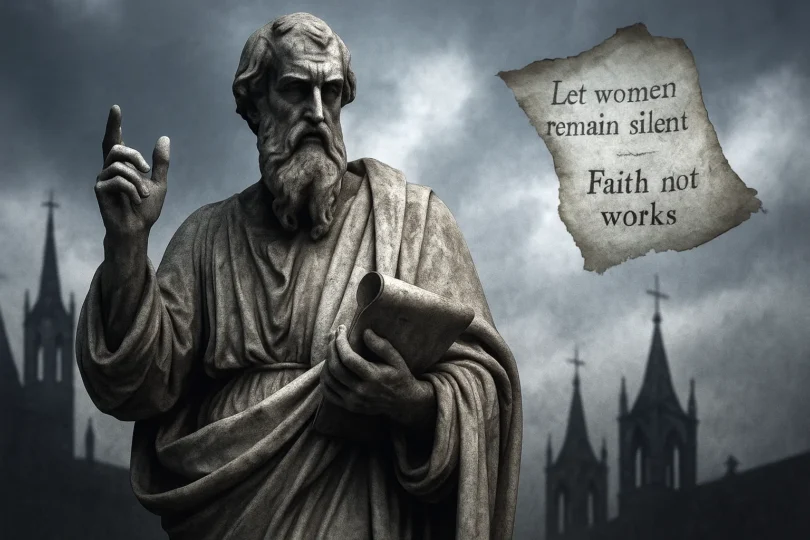

A perfect stranger to Jesus rewrote the faith, silenced women, helped build a religion of control, and eventually became the face of homophobia in Christianity. But were his failings malicious?
Some time ago, I wrote a piece that got a lot of strong reactions. I posed a strange but serious question: If Paul really was an apostle, was he more likely chosen by Jesus — or by Satan? It was meant as a thought experiment, not a declaration. Some thought I was being way too critical, while others just saw the word “Satan” and jumped to conclusions.
I’m not a big fan of Paul, but I’m not calling him evil. I’m not even saying he was malicious. When I criticize him, it’s not because he failed to be perfect — it’s because he claimed divine inspiration, yet often failed to rise above the average thinking of his time. This piece is simply an attempt to explain what I meant — without fire and brimstone, just plain honesty. Because Paul’s legacy deserves a closer look, even if that makes some people uncomfortable.
Paul Was a Man of His Time — And That’s the Problem
First of all, it’s misleading to categorize any historical figure as either entirely good or entirely bad. Even the most destructive individuals may have done some good — like certain economic policies under the early Nazi government — and even admired leaders made serious mistakes, like Churchill opposing women’s right to vote.
Paul was writing 2,000 years ago, and that’s important context. Back then, women were treated like property, slavery was just the way of the world, and most people saw same-sex attraction as scandalous at best, sinful at worst. So when Paul said women should be quiet, or when he called same-sex relations “unnatural,” he wasn’t inventing new hate. He was just repeating the default settings of his culture. He wasn’t the worst guy on the block. He was the guy on the block — and sometimes that guy is the most dangerous thing there is.
If the Church had left his letters in a dusty corner, we wouldn’t be talking about him today. But instead, they were copied, debated, and eventually voted in as the Word of God. His first-century worldview, his personal hang-ups, maybe even his unprocessed trauma, got repackaged as the will of the Almighty.
The Real Damage — Authority Without Accountability
Jesus never wrote a line. His handpicked disciples never wrote down his teachings. Sorry, but by the time the Gospels of Matthew or John were written, all of Jesus’ original disciples were long gone.
But Paul? He dashed off letter after letter.
Furthermore, half of the New Testament is tied to his name because the Church liked what he was selling. We don’t know whether they realized that half of those letters weren’t actually written by him — or if they included them anyway to give his views more authority. For example, 1 Timothy lays out a strict church hierarchy — bishops, deacons, rules for women — but even most Christian scholars today agree Paul didn’t write it. It was forged in his name, likely decades after his death, to solidify control as the early church became more institutional. Either way, Paul ends up getting credit (or blame) for things he never even said.
Still, the letters we do know Paul wrote are damaging enough. He transformed a small Jewish reform movement into a faith tailor-made for the Roman world, aimed squarely at Gentile ears. He set aside Jewish law, elevated belief over behavior, and turned Jesus from a rebellious rabbi into a cosmic pardon slip — handed out to anyone who believes hard enough.
Paul rewrote the faith, trailblazing a version that carries his personal trademark.
Was Paul Homophobic and Misogynistic? No doubt.
Paul told women to stay silent in worship. He insisted they cover their heads, and he demanded that wives submit to their husbands as the church submits to Christ. That’s not liberation. That’s authority cloaked in holy language.
And the passages about queer people? Romans 1 has become the darling of anti-LGBTQ+ sermons. Those verses have been used to shame, exile, and even justify violence against people simply living their truth. Whether Paul meant to start a culture war or not, his words lit the match.
Some defenders plead that Paul was only condemning temple prostitution, or that he wasn’t talking about “good” women. That’s just apologetic acrobatics. He wrote what he wrote. And for generations, his words have been wielded to keep others in chains.
To be fair, even much-celebrated scientist Charles Darwin believed white people were inherently superior to Black people, and men superior to women. He was a 19th-century European man, writing after the Enlightenment and the scientific revolution. Britain was still prosecuting gay men for “gross indecency” until the 1960s.
So I don’t blame Paul much for holding the views of a first-century man in the ancient Near East. The problem isn’t just what he believed — it’s that he claimed those beliefs were divinely inspired. And unless you’re ready to say that God couldn’t possibly know better, that claim should make you pause.
Intent vs. Impact
Of course, Paul couldn’t possibly foresee the ripples of his opinions. He couldn’t picture people in 2023 waving his letters as weapons against same-sex marriage or using them as excuses to stop women from preaching. He never signed off on megachurches or Christian nationalism and certainly wasn’t trying to gift the world a new religion. He just wanted to guide a community he believed Jesus envisioned.
Paul had big confidence and shaky clarity. Somehow, the Church declared his letters the new gospel.
So no, he wasn’t scheming in the shadows. But years later, the things he said about obedience, submission, and sin became the kind of blueprints that let religious abuse slide, opened doors to discrimination, and turned faith into a power game.
Is It Fair to Call Him Evil?
That depends on what you think evil really is.
If evil is just hurting people on purpose, you might not call Paul evil. If it’s passing out loaded guns and calling them gifts from God, then yeah, maybe he comes closer.
Do we excuse his sexism and homophobia just because he was “a man of his time”? Or do we finally say: Look, these ideas were harmful then, and they’re even worse now?
You don’t have to destroy his letters, but you don’t have to treat them like they were sent from heaven, either.
Paul as the Second Jesus
This is the heart of the matter.
Today’s Christians — especially the fundamentalists — quote Paul more than Jesus. They build entire belief systems on his sentences. They skip the Sermon on the Mount and cling to “faith, not works” like it’s a life raft.
Jesus said, ‘Feed the hungry, forgive everyone, and love the people who hate you.’
Paul said Follow the rulers, don’t stir the pot, stay in line.
Go ask the church today which one they talk about most.
Paul turned a radical message into a rulebook. He flipped a revolution into a religion. That’s not evil. But it sure as hell isn’t progress.
Before You Go
So Was Paul Simply Evil?
No. But he wasn’t harmless.
He didn’t walk with Jesus. He didn’t hear the parables firsthand. Yet somehow, he hijacked the message, reshaped it to fit the Roman world, and stamped it with divine approval. Whether or not he meant to, his words helped silence women, shame queer people, and build a religion obsessed with control.
He was a man with a pen, a platform, and a lot of power — and history shows what happens when that combo gets mistaken for the voice of God.
Comments
Bmiller
Yeah, I still don’t like Paul.
Frank Holtry
It’s not clear to me that Paul had any written sources from anyone who actually saw or heard Jesus. Dr. Ehrman suggests some more literate people attending Jesus’ speeches may have made notes from which the gospels may in part have been written, but the gospels themselves were written after Paul’s time. Thus he either had a direct pipeline to God, which is highly unlikely, or he made it all up from whole cloth. The preference for love, as in the “golden rule”, predates both Jesus and Paul by several hundred years.
Tanner the Humanist
Great points, Frank, and you’re right to raise the question of sources. Paul never quotes Jesus directly in any meaningful way—not his parables, not the Sermon on the Mount, not even the Lord’s Prayer. For someone claiming divine revelation and apostleship, that absence is deafening.
If Paul had access to any eyewitnesses or early sayings of Jesus, he doesn’t show it. He repeatedly insists that his gospel came not from any human being, but by direct revelation (Galatians 1:12). So we’re left with two options: either he really did have a hotline to heaven—or, more plausibly, he invented a theological system based on his own experiences and adapted bits of Jewish and Hellenistic thought.
And you’re absolutely right about the “golden rule”—it existed long before either of them. It’s in Confucius, Hillel, and others. What Paul did was universalize a version of moral conscience and claim it came through Christ, while offering very little that can be traced back to the historical Jesus.
Russell
Paul was recruited to join an existing movement. Somebody else made it up.
The time setting of the gospel story precedes Paul’s time, suggesting who might have made it up and recruited Paul.
I say Herodias, but there are very many distracting magic tricks that keep everybody’s attention. It’s also intentionally confusing that the story was written to invoke sympathy for the opposing side.
Perfectly Torah adherent hero > magic trick > Torah is abolished. That’s the story. In whose interest was it made up? The Torah-adherent would lack motive. There was no supernatural event but one was claimed. By Torah-non-adherent Jews?
Look! Gentiles! Another made up distraction. This is about Jews and whether they will obey the Law. No, they will not it says.
Seth
Thanks for this elaboration on your earlier work. I have always been interested in how Paul shaped Christianity.
Regarding Charles Darwin, our perception of him and his views is unfortunately colored by misrepresentation of him by Creationists, who feel if they can discredit Darwin the man, that they undermine evolution (and they are mistaken).
While Darwin was indeed a product of his time and place, he was far from typical, and his views would have been thought of as very progressive by his peers.
This article provides an alternative view:
https://rationalwiki.org/wiki/Charles_Darwin#False_controversies_against_Darwin
Russell
Still, the letters we do know Paul wrote are damaging enough. He transformed a small Jewish reform movement into a faith tailor-made for the Roman world, aimed squarely at Gentile ears….
I’m a big fan of Paul.
There was an intra-Jewish conflict over Torah law. How seriously should Jews take it? The Jews who said ‘very seriously’ fought against Rome over that. Three wars. The Jews who said, ‘wait, that’s stupid’ were the earliest Christians.
Tanner, you buy the Christian apologetic argument that Jews were no longer involved in Christianity within the first few decades. What happened to the 80% of Jews who lived in the Jewish Diaspora, spread throughout the entire Roman Empire. They disappeared? Did Jewish Torah observance decrease proportionally to distance from the Temple? Very likely.
Gospel writers Mark and Luke were associates of Paul, not disciples of Jesus. The gospels and Paul are on the same page. I claim the gospel authors recruited Paul to join their movement. (I show my work.)
The Christian movement was not led by a Jew who was perfectly adherent to Torah. It was led by Paul who advocated abolishing Torah – for Jews. The NT authors stole the original guy’s reputation and told much different stories about him. Supernatural stories about why Jews no longer needed to adhere to Torah. And non-Jews can join too (since we have sex with them). It’s not real history. It’s theology and very very Jewish.
Paul turned something into a rulebook? Paul said our conscience is the real law – above Torah – given to all humans by God. Fundamentalist and Evangelical Christian churches turned Paul into a rulebook.
Leonard the Lumenist
If he didn’t meet Jesus then no one can. Do you hear yourself?
This following verse is evil, you have said that this is evil. It’s clearly not, so what does that make you?
4 Love is patient, love is kind. It does not envy, it does not boast, it is not proud. 5 It does not dishonor others, it is not self-seeking, it is not easily angered, it keeps no record of wrongs. 6 Love does not delight in evil but rejoices with the truth. 7 It always protects, always trusts, always hopes, always perseveres.
“8 Love never fails. But where there are prophecies, they will cease; where there are tongues, they will be stilled; where there is knowledge, it will pass away. 9 For we know in part and we prophesy in part, 10 but when completeness comes, what is in part disappears. 11 When I was a child, I talked like a child, I thought like a child, I reasoned like a child. When I became a man, I put the ways of childhood behind me. 12 For now we see only a reflection as in a mirror; then we shall see face to face. Now I know in part; then I shall know fully, even as I am fully known.
13 And now these three remain: faith, hope and love. But the greatest of these is love.”
Steve Ruis
Re ‘Is It Fair to Call Him Evil?”
No. Misguided, deluded, power hungry, status seeking, etc., etc. But the “Church” meaning the proto-orthodox church didn’t need to hew to his lines. It was the “Church Leaders” who wielded their religion as a control mechanism over people to give them power. Paul was just the tool, he churchmen were the tool users. And this continues to this day. Misguided, bad churchmen sell bonkers madness under the label of Christianity: the prosperity gospel? GMAFB.
In continues to this day. One common trope you’ll see every damned day, somebody writing “You are thinking about God correctly!” Right, because they know and you don’t.
Mister X
Whether or not Paul was evil depends on how one defines evil. In the case of vicious criminals who commit random and senseless violent crimes against innocent humans who were minding their own business and didn’t even do anything to them to deserve it, definitely vile and evil. However in Paul’s case, Stephen was given a choice, stop blaspheming our Jewish religion and our Torah or die. Stephen of course chose to die a martyr, still not a nice thing to do to another human being but at least he was given a choice to save his own life. As far as some to most of his beliefs, wrong of course except if you’re someone who actually believes that there is some angry and jealous god up there who’s ready to throw you into an eternal hell unless you blindly follow and worship him, it’s more understandable.