The strange story of “the Logos”
If you go to look into the earliest records of Christianity, you’ll see the strangest thing. The deity is called another name—a word that later almost disappears from the religion.
You might think of him as “Jesus,” but to the first Christians, that was only the human name of the Son of God. To speak of his divine nature, one called him “the Logos.”
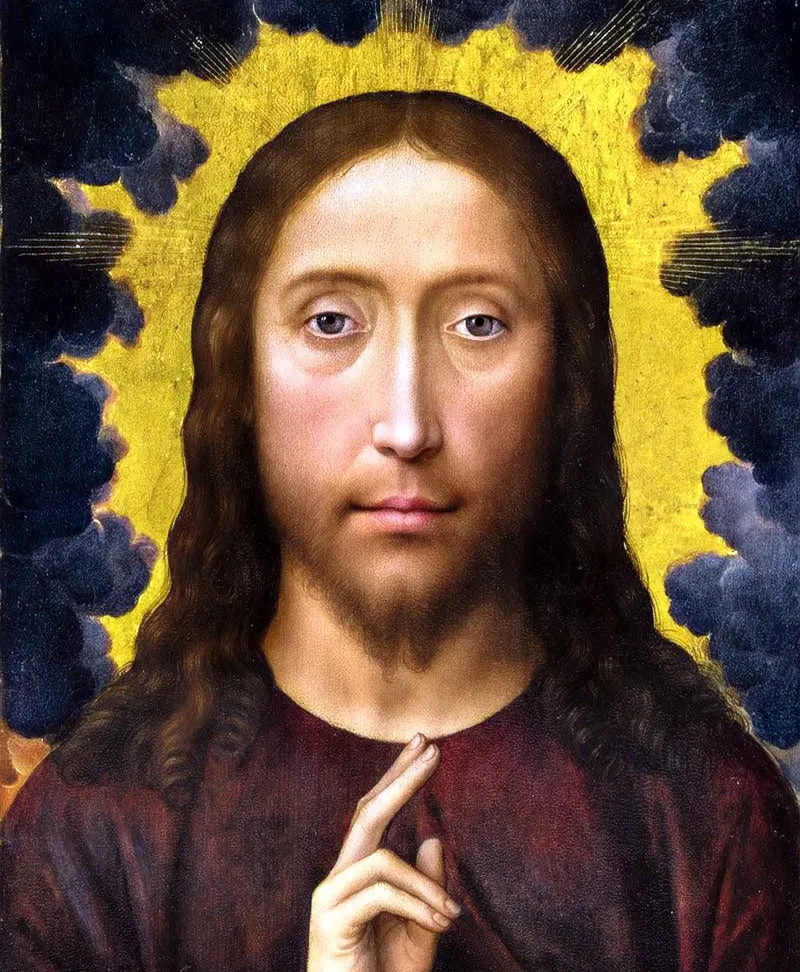
I grew up Christian, and “Jesus” was a kind of mascot for national and cultural power.
Christians like to talk up “Jesus” as God. But what “Jesus” meant, practically, was a symbol of a set of values, about family, community, politics. Is that a ‘religion’? Day to day, Christianity is a lifestyle choice—even if it’s explained as how you get to Heaven.
Then you might notice how often Christianity instills the values that empires want their citizens to follow. From the Roman Empire on, many empires have used Christianity to herd, to police, to colonize.
Or as we called it: evangelize.
Christianity’s earliest texts describe a very different religion.
This is a notorious problem in “patristic” studies. The first Christian interpreters often don’t read like “Christian” in any recognizable way.
As the Catholic scholar Jean Daniélou once put it: “Few things are more disconcerting for the modern man than the Scriptural commentaries of the Fathers of the Church.”
The ‘Fathers’ cite Bible verses that don’t exist, or not as seen in any Bible today. They often have theological ideas that read to us as bizarre. But what’s most confusing is when they keep referring to Jesus as “the Logos.”
Christians these days have heard the “Logos” talk.
There is one passage in the New Testament in particular in which it really can’t be ignored: the prologue to the Gospel of John. As a scholarly translation of that passage goes:
“In the beginning was the Logos,
and the Logos was alongside God,
and the Logos was god.
All things came into being through it,
and without it not one thing came into being.”
This seems to be a story that echoes the Creation account in the Bible’s book of Genesis. But this “Logos” isn’t seen back in Genesis, is it?
So who was “the Logos”?
Well, Christians these days would say the “Logos” wasn’t anyone. That was just a strange way that the author of the Gospel of John would talk, i.e. a special, weird “Johannine” reference for Jesus.
The “Logos” would be explained as just the Greek word for “word,” and so Jesus was just being compared to text. And isn’t his story told in a book, i.e. the Bible? So basically, they’d say, it just means that.
You might otherwise have thought that “Logos” was really the Christian deity’s name.
In Revelation 19:13, for example, you’d read: “his name is the Word of God.” Whenever the ‘Word’ appears in the Bible, it could be a deity’s name.
Scholars sometimes note, for example, that a reference to the “Word” in the prologue of Luke’s gospel could be used as a proper name. It’s read these days to just have him say he’s writing about the “word” spreading.
If it’s about the Logos, all the terms rearrange and the text becomes a very different text—about a long effort by ‘servants of the Logos’ to tell its story.
“Since many have undertaken to set in order a narrative of the things that have been brought to full realization among us, just as those who from the beginning were eyewitnesses and servants of the Logos handed them down to us…”
The letters of Paul also seem to suggest that Jesus is a cosmic being with a long backstory.
An array of unusual passages sound a lot like John’s “Logos” talk, about deity a deity who is the “firstborn,” involved in Creation, and is Creation.
On and on it goes. Is it even Christian?
“The Son is the image of the invisible God, the firstborn over all creation. For in him all things were created: things in heaven and on earth, visible and invisible, whether thrones or powers or rulers or authorities; all things have been created through him and for him. He is before all things, and in him all things hold together.” (Col. 1:15–17; cf. Heb. 1)
All this “Logos” and “Son” talk is hazy.
But one after another, the ‘Fathers’ of early Christian history called Jesus ‘the Logos’. They thought of him as a divine being who had come into view or come into existence at Creation.
The writer of the Letter to Diognetus tells the story of the Gospels as the story of “the Word” who “appeared and spoke openly…the One from the beginning” (11.2–5).
Ignatius of Antioch refers to “Jesus Christ his Son, who is his Logos which came forth from silence” (Magnesians 8.2). Justin Martyr explains Christianity in Dialogue with Trypho: “God has begotten of himself a certain rational power as a ‘Beginning’ before all creatures” (Dial. 61). This divine being, Justin adds, has gone by many names: the Logos, the Son, the Glory of the Lord, Wisdom, an Angel, Lord.
Tatian writes in his Oration to the Greeks: “God was in the beginning, and we have received that the Beginning is the power of the Logos” (5.1).
Some Christian teachers had a lot more “Logos.”
Often, reading early Christian writings, it’s really not clear they’re recognizably Christian. Theophilus of Antioch, around 180 CE, writes:
“This Word is called the ‘Beginning’ because He rules and has dominion over all things created through Him. Therefore, this One, being the Spirit of God, the Beginning, Wisdom, and Power of the Most High, came down into the prophets and spoke through them about the creation of the world and all other things.” (2.10)
A Christian wouldn’t see Jesus as a divine being narrating the Bible through prophets, though that seems the implication here.
Was the Logos ‘born’ at Creation?
That’s a common idea, as when Lactantius writes in The Divine Institutes refers to Creation as a birth: “He was born twice: first in the Spirit, and afterward in the flesh” (4.9).
Then when you get to the Alexandrian teachers, Clement and Origen, they write at length about the Logos as a divine being—except in terms that later don’t seem so “Christian’ at all. Clement of Alexandria writes:
“The Son also is called Logos, in name only like the paternal Logos; but this one is not he who became flesh, nor yet the paternal Logos, but a certain power of God, as an emanation of his Logos, having become mind, which has gone forth into the hearts of men.” (Photius, Cod. 109)
For Origen, Jesus was a man who had the Logos within him.
The Alexandrian teacher referred to Jesus as “the divine Logos, the power and wisdom of God, the so-called Christ.” Origen reads the Gospels to have Jesus sometimes speaking as a man and sometimes as a cosmic spirit:
“…it was the divine Logos and Son of the God of the universe that spoke in Jesus, saying: ‘I am the way, the truth, and the life’, and ‘ I am the door’, and ‘I am the living bread that came down from heaven’, and any other such saying” (Cels. 2.9)
Is that Christian?
It wasn’t where I came from. But for us, ‘Jesus’ was a divine being who was mostly understood to have appeared in the Nativity story.
The “Logos” disappeared into “word.” Any unusual comments on the Logos by various ‘Fathers’ were explained as those writers reading a little too much Plato, or something. It’s a warning against Christians reading!
This is a very different idea than the way early Christians had explained it. For them, the pagan philosophers sensed what Jesus revealed.
Christians suppressed the “Logos” talk.
It was removed in translation of the Bible and downplayed in the writings of the ‘Fathers’. Irenaeus was big into the Logos. But as a 2012 study finds:
“Irenaeus of Lyons rarely is considered a Logos theologian, despite the prevalence of λóγος as a christological title in his works. The reason for this neglect in early twentieth century scholarship was the common assumption that Logos theology, as a product of the ‘Hellenistic mind,’ was out of place in the ‘biblical theology’ of Irenaeus.”
But really, Christianity changed deities.
It’s understandable enough. The cosmic ‘Logos’ stuff would have no appeal to the Roman empire which was absorbing the religion. The story of a cosmic spirit that is present in all created things, and speaks to humans, wouldn’t be so interesting at all.
There seems to have been a kind of early Christian meditation taught for communicating with the Logos, as if the ‘spirit’ the universe can be contacted through dreams, visions and inspired moments.
Now it’s all hazy, and discussed by scholars in papers and books that wouldn’t be read by the public.
Mostly, Christianity just wants you to ‘behave’—for which sitting in church is the practice.
Jesus is not seen as the Logos or a spirit “through whom” everything was created. To see ‘Jesus’ in nature would be irreligious. It seems more pagan, even? Heathens believe that kind of talk.
The “Logos,” where it comes up, is regarded as just some strange talk—or the traces of a previous religion they couldn’t erase?